Tag Archives: conversion optimization

Click-Through Rate vs Watch Time: What Matters More in Video Marketing

Video marketing has become one of the most powerful ways to grow a business online, but it has also become one of the most misunderstood. Many creators obsess over numbers without fully understanding what those numbers actually represent.

Two metrics usually sit at the center of the debate: Click-Through Rate (CTR) and Watch Time. At first glance, they seem to compete with each other. One measures how many people click. The other measures how long they stay.

But in reality, they are not rivals at all. They are two stages of the same journey.

If you want consistent growth on platforms like YouTube, Facebook, or TikTok, you need to understand not only what these metrics mean—but how they influence each other.
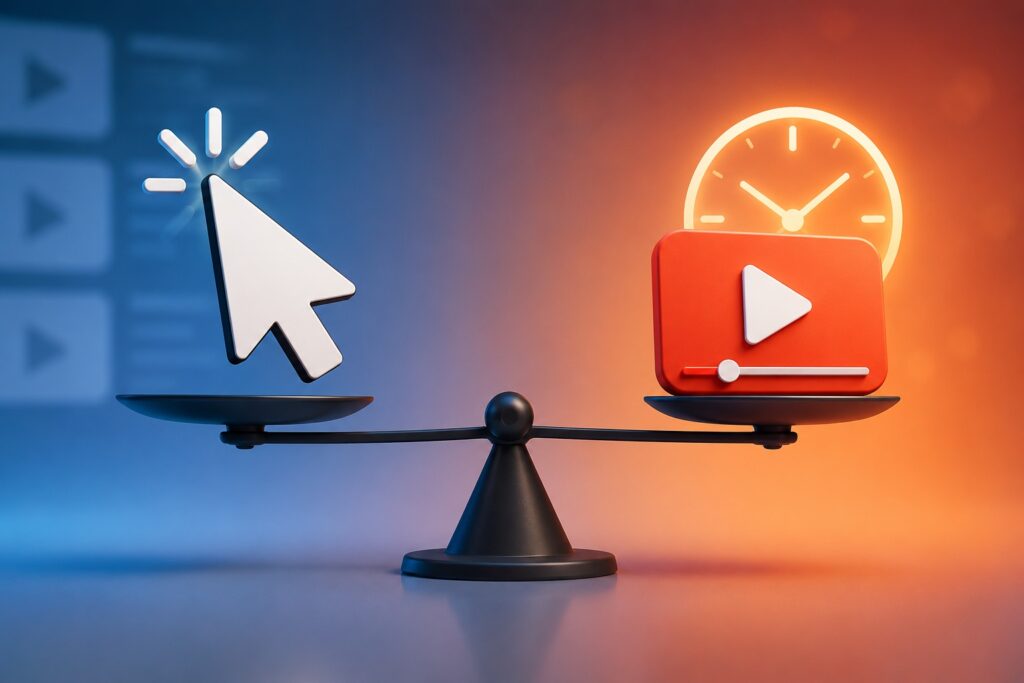
Click-Through Rate vs Watch Time: What Matters More in Video Marketing
Generated by ChatGPT

Why Video Metrics Matter More Than Ever

In earlier forms of marketing, success was measured in simple exposure. How many people saw your ad. How many impressions you bought. How many eyeballs were reached.

Video marketing changed that completely.

Today, platforms don’t just care about whether someone saw your content. They care about what people did after seeing it. Did they click? Did they stay? Did they engage?

That shift is why CTR and Watch Time became so important. They are no longer vanity numbers. They are signals that determine whether your video gets pushed to more people or quietly disappears.


What Click-Through Rate Actually Tells You

Click-Through Rate is often misunderstood as a success metric, but it is really a curiosity metric.

It answers one simple question:

“Did your video look interesting enough for someone to click?”

CTR is shaped before anyone even watches your content. It depends on how your video is presented in the feed.

This includes:

  • The thumbnail
  • The title
  • The topic framing
  • Audience targeting
  • Emotional appeal

A high CTR usually means your packaging works. People see it and think, “I want to know more.”

But CTR alone does not guarantee success. It only gets someone through the door.


What Watch Time Really Measures

Watch Time is where reality shows up.

Unlike CTR, which is about attraction, Watch Time is about retention. It measures whether your content can actually hold attention once someone clicks.

This includes:

  • How long people stay
  • When they drop off
  • Whether they finish the video
  • Overall audience retention

Watch Time tells platforms something very important:

“This content delivered on its promise.”

If CTR is the invitation, Watch Time is the experience.

And in most modern algorithms, experience matters more than curiosity.


The Hidden Relationship Between CTR and Watch Time

It’s easy to treat these two metrics separately, but platforms don’t.

They evaluate them together as a sequence:

  1. A user sees your video (impression)
  2. They decide whether to click (CTR)
  3. They decide whether to stay (Watch Time)

If either step fails, the chain breaks.

A video with high CTR but low Watch Time sends a negative signal. It tells the platform that the packaging worked, but the content didn’t deliver.

On the other hand, a video with low CTR but high Watch Time struggles to scale. It performs well only after people find it, but not enough people ever see it.


When CTR Is High but Watch Time Is Weak

This is one of the most common problems in video marketing.

It usually happens when:

  • Titles are too sensational
  • Thumbnails are misleading
  • Expectations are inflated

At first, everything looks promising. Views come in quickly. The CTR looks strong.

But then something changes.

People start leaving within seconds. Retention drops. The algorithm slows down distribution.

What went wrong is simple: the video attracted attention but didn’t sustain it.

Over time, platforms stop recommending it because it fails to satisfy viewers.


When Watch Time Is Strong but CTR Is Low

This is a quieter problem, but just as limiting.

Here, the content itself is solid. People who watch tend to stay. Engagement is strong. The video performs well internally.

But it never gets enough exposure.

Why?

Because the packaging doesn’t trigger curiosity.

Weak thumbnails, unclear titles, or poor positioning can all reduce CTR. And if people don’t click in the first place, even great content stays hidden.

In this case, the video is valuable—but invisible.


So Which Metric Matters More?

If you look at how modern platforms operate, the answer becomes clearer.

Watch Time carries more long-term weight because it reflects satisfaction and content quality.

However, CTR is still essential because it determines whether your content gets tested in the first place.

A simple way to think about it is this:

  • CTR opens the door
  • Watch Time determines how long you stay inside

One without the other creates imbalance.


How Platforms Actually Evaluate Your Video

Most major platforms don’t look at metrics in isolation. Instead, they evaluate performance in stages.

Stage 1: Exposure and Clicks

Your video is shown to a small audience. The platform measures CTR to see if people are interested.

If CTR is too low, distribution slows immediately.


Stage 2: Engagement and Retention

If people click, the platform watches behavior closely.

  • Do they stay?
  • Do they leave early?
  • Do they watch more content afterward?

This is where Watch Time becomes critical.


Stage 3: Satisfaction Signals

Beyond watch behavior, platforms also track:

  • Likes
  • Comments
  • Shares
  • “Not interested” clicks

These signals help refine future recommendations.

Together, these stages decide whether your video grows or fades.


How to Improve Click-Through Rate Naturally

Improving CTR is less about tricks and more about clarity and curiosity.

Strong CTR usually comes from:

  • Clear, high-contrast thumbnails
  • Titles that create curiosity without confusion
  • Topics that match audience intent
  • Emotional or outcome-driven framing

The goal is not to exaggerate—but to make people want to understand more.


How to Improve Watch Time Effectively

Watch Time improves when the content itself respects attention.

That means:

  • Starting quickly without long introductions
  • Delivering value early in the video
  • Keeping pacing dynamic
  • Avoiding unnecessary filler
  • Matching what the title promised

A viewer should never feel like they clicked into something different from what they expected.


The Real Strategy: Balancing Both Metrics

The strongest video marketing systems don’t optimize for CTR or Watch Time alone. They build alignment between them.

When your packaging and your content match, something powerful happens:

  • More people click
  • More people stay
  • The algorithm gains confidence
  • Distribution expands

This creates a compounding effect where each new video performs better than the last.

source: Nick Nimmin

Final Thoughts

Click-Through Rate and Watch Time are often discussed as if one must be more important than the other. But in reality, they are part of the same system.

CTR determines whether your video gets attention.
Watch Time determines whether it deserves more.

If you want sustainable video marketing growth, the goal is not to choose between them—but to build a structure where both naturally improve together.

That’s what separates videos that get a few views from videos that consistently grow over time.

The written content on this page was generated by ChatGPT.

Why Testimonial Videos Are One of the Most Powerful Marketing Tools

Most businesses say the same thing: “We’re the best,” “We deliver quality,” “We care about our customers.” The problem is, those claims don’t mean much on their own anymore. People hear them all the time, across every industry, from every competitor.

What actually breaks through that noise is something far more grounded—real customers sharing real experiences in their own words. That’s where testimonial videos come in, and why they’ve become one of the most effective tools in modern marketing.

Unlike polished advertisements, testimonial videos don’t try to convince in a traditional sense. Instead, they show proof. And in today’s environment, proof matters more than promotion.

Why Testimonial Videos Are One of the Most Powerful Marketing Tools
image generate by ChatGPT

Why People Trust Other People More Than Brands

There’s a simple reason testimonial videos work so well: people trust other people more than they trust companies.

When someone is deciding whether to buy a product or hire a service, they naturally look for reassurance. They want to know if it has worked for someone else, especially someone who seems relatable.

This is where psychology plays a big role. Humans rely heavily on social proof when making decisions. If others have had a good experience, it reduces uncertainty. It makes the choice feel safer.

A written review can help with that, but video goes further. When you see a real person speaking, you pick up on details that text cannot carry—tone, emotion, hesitation, excitement, confidence. All of these signals shape how believable the message feels.


The Difference Between Hearing It and Seeing It

There’s a major gap between reading a testimonial and watching one.

A written review might say:
“Great service, highly recommended.”

But a video shows someone explaining:
what problem they had,
why they were frustrated,
how they discovered the solution,
and what actually changed afterward.

That narrative structure matters. People don’t just want praise—they want context. They want to understand the journey.

Video makes that journey visible. It adds facial expressions, voice tone, and real reactions. Those small details make the story feel less like marketing and more like a conversation.


Why Testimonial Videos Build Trust Faster Than Anything Else

Trust usually takes time to develop. Businesses often spend months or even years building credibility through branding, content, and advertising.

Testimonial videos speed up that process significantly.

Instead of a company trying to convince a potential customer, the message comes from someone who has no obligation to promote the brand. That difference changes how the message is received.

It lowers skepticism. It reduces hesitation. And it replaces “Is this really true?” with “This seems to have worked for them.”

In many cases, that shift is enough to move someone from browsing to buying.


Why Video Testimonials Convert Better Than Written Reviews

Written testimonials still have value, but they are easy to overlook. People scroll past them, skim them, or question their authenticity.

Video, on the other hand, demands attention.

It also holds attention longer. When someone is watching a testimonial video, they’re not just reading words—they’re observing a real human experience unfold. That engagement increases the chances that the message will actually stick.

There’s also an emotional element. A satisfied customer speaking with genuine enthusiasm is far more persuasive than text alone. Emotion plays a major role in decision-making, even when people think they are being purely logical.


How Testimonial Videos Influence Every Stage of Buying Decisions

Testimonial videos are useful at every stage of the customer journey.

At the beginning, they introduce your brand in a relatable way. Instead of a business explaining what it does, a customer explains what they experienced.

During the consideration stage, they help compare options. When someone is weighing different providers, real feedback often becomes the deciding factor.

At the final stage, they reduce doubt. Even when a customer is close to making a decision, hesitation can still appear. A strong testimonial can remove that final barrier.

This is especially true in industries where trust is essential—services, healthcare, coaching, real estate, and high-ticket products.


Authenticity Matters More Than Production Quality

One common mistake businesses make is overproducing testimonial videos. While high-quality visuals can be helpful, perfection is not the goal.

What actually works best is authenticity.

A slightly imperfect video, where a customer speaks naturally and casually, often feels more believable than a heavily scripted production. People can tell when something feels rehearsed, and that can reduce trust instead of building it.

What matters most is honesty. If the emotion is real, the video works.


How Businesses Should Approach Testimonial Videos

Getting effective testimonial videos is not about asking customers to repeat marketing messages. It’s about guiding them to tell their story.

A simple structure works best:
What problem did they have?
Why was it important to solve it?
What made them choose your business?
What happened after using your product or service?

This structure creates a natural narrative that viewers can follow easily.

Placement also matters. Testimonial videos should not be hidden away on a separate page. They perform best when placed where decisions are made—landing pages, product pages, checkout pages, and even social media ads.


The Impact on Conversions and Sales

Testimonial videos often have a direct effect on conversion rates.

When people see others achieving results, it reduces perceived risk. Buying anything involves uncertainty, and testimonials help remove that uncertainty by showing real outcomes.

This is why businesses that use testimonial videos often see stronger performance metrics, including higher engagement, longer time on page, and better sales conversions.

It’s not just about persuasion—it’s about reassurance.


Where Testimonial Videos Are Heading Next

As online competition continues to grow, trust will become even more important. And video is becoming the most natural way to build that trust at scale.

We are also starting to see new developments in personalization and distribution. Businesses are beginning to use testimonial content more strategically, matching different testimonials to different audience segments.

In the future, testimonial videos may become even more targeted, interactive, and integrated into customer journeys.

But even with all the changes in technology, the foundation remains the same.

People trust people.

That is something marketing will never replace.

source: Aleric Heck

Final Thoughts

Testimonial videos are powerful because they don’t feel like marketing. They feel like experience sharing. That difference is what makes them so effective.

They shorten the trust-building process, reduce hesitation, and help potential customers feel more confident in their decisions.

In a digital world filled with claims and promises, real voices stand out. And those real voices often make the difference between someone just looking—and someone actually buying.

The written content on this page was generated by ChatGPT.
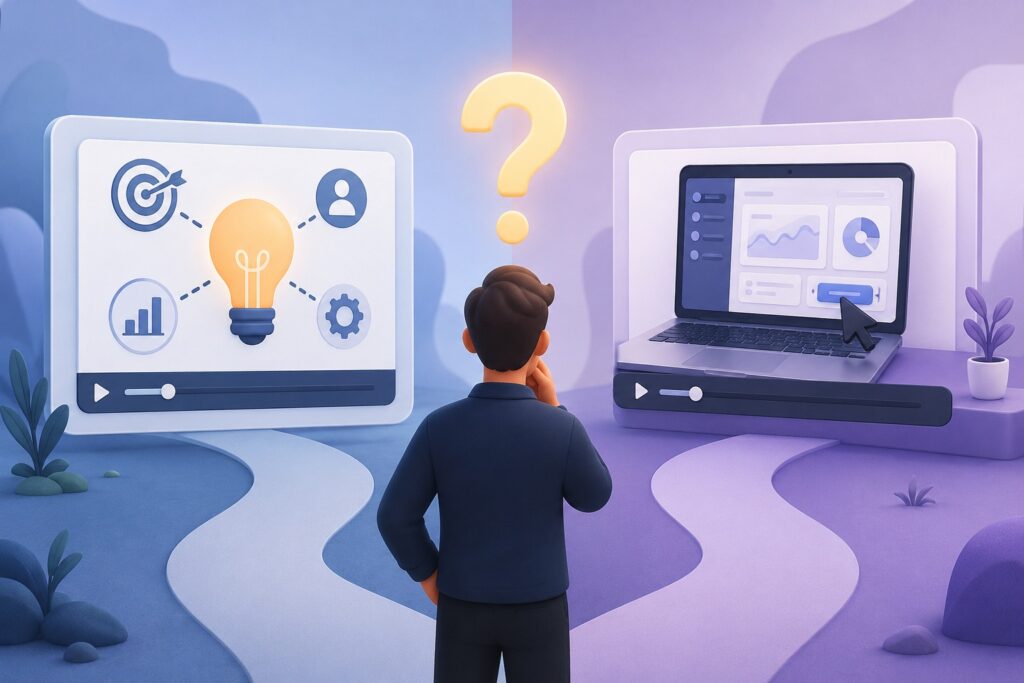
Explainer Videos vs Product Demo Videos: Which One Should You Use First?

Most businesses don’t struggle with whether video marketing works. That part is already settled. The real challenge shows up much earlier—choosing what kind of video to start with.

Two of the most commonly used formats are explainer videos and product demo videos. On the surface, they might look similar. Both are short, both are promotional, and both are used to increase sales. But in practice, they serve very different roles in your marketing strategy.

So the real question is not just what they are—but which one actually makes sense to create first when you’re starting from zero or building a new campaign?

To answer that properly, it helps to understand how each one behaves in the real world.

Explainer Videos vs Product Demo Videos: Which One Should You Use First?

What an Explainer Video Actually Does for Your Business

An explainer video is usually the first “conversation” your business has with a potential customer.

At this stage, people don’t really know you yet. They may have landed on your website, seen a social post, or clicked an ad out of curiosity. They are not looking for deep technical details. They are still trying to answer something very basic:

“What is this, and why should I care?”

That’s exactly where explainer videos perform best.

Instead of focusing on features or step-by-step usage, they focus on clarity. They take something that might be complicated—like a service, software, or business model—and turn it into something easy to understand in under two minutes.

Where explainer videos really shine

They are especially effective when:

  • Your product or service is new to the market
  • Your idea needs context before it makes sense
  • Your audience is cold and unfamiliar with your brand
  • You need to simplify something technical or abstract

A good explainer video removes confusion. And in marketing, clarity often comes before interest.

For example, if a company offers a subscription-based cleaning service, most people won’t immediately understand how scheduling, pricing, or recurring visits work. An explainer video can walk through that entire experience in a simple story, helping the viewer understand the value without effort.

That “instant understanding” is what makes explainer videos powerful at the beginning of a customer journey.


What a Product Demo Video Actually Focuses On

A product demo video comes in at a very different stage.

By the time someone is watching a demo, they already have some level of interest. They are no longer asking what the product is. Instead, they are asking something more practical:

“How does it actually work, and will it solve my problem?”

This is where detail matters.

Unlike explainer videos, demos don’t simplify the idea—they prove it. They show the product in action, often step by step, so the viewer can visualize exactly what owning or using it would feel like.

Where product demo videos perform best

They are most effective when:

  • Your audience already understands the product category
  • You’re targeting warm leads or returning visitors
  • The purchase decision depends on features or usability
  • You need to reduce hesitation before buying

For example, if you’re selling a project management tool, the audience likely already knows what such tools do. What they need now is confidence. A demo video showing task creation, team collaboration, and workflow automation helps remove doubt and makes the decision easier.

In other words, demos don’t introduce—they reassure.


The Real Difference Between the Two

Although both formats sit under video marketing, they operate at different stages of persuasion.

Here’s a simple way to think about it:

  • Explainer videos build understanding
  • Product demos build confidence

That difference changes everything.

Explainer videos are emotional and conceptual. They focus on the “why.”
Product demos are logical and functional. They focus on the “how.”

One prepares the audience. The other convinces them.


So Which One Should You Create First?

If you’re just starting out, the safest and most effective answer is usually this:

Start with an explainer video.

That might feel less exciting, especially if you’re eager to show off your product. But in most cases, skipping the explainer stage creates a hidden problem—people don’t fully understand what you do, which means they don’t engage deeply enough to care about the demo.

There are a few reasons why explainer videos typically come first:

1. Most audiences need context before details

If someone doesn’t fully understand your offer, showing them features won’t help. It only adds more confusion.

2. Cold traffic needs simplicity

People seeing your brand for the first time are not ready for technical explanations. They need a clear message before anything else.

3. It forces you to refine your message

Creating an explainer video forces you to simplify your business into its core idea. That clarity improves everything else—ads, landing pages, and even sales conversations.


When a Product Demo Should Come First Instead

There are situations where starting with a demo actually makes more sense.

For example:

1. Your product category is already familiar

If people already understand what your product is (like smartphones, apps, or tools), you don’t need to explain the concept—you just need to show what makes yours better.

2. You already have warm traffic

If visitors are already aware of your brand, a demo becomes more powerful than another introduction.

3. Your focus is direct conversion

If your goal is immediate sales rather than awareness, demos can push people closer to purchase faster.


The Most Effective Strategy: Use Both in Sequence

The real strength of video marketing comes when you stop thinking in terms of “which one is better” and start thinking in terms of “what order makes sense.”

A strong funnel often looks like this:

Stage 1: Awareness

  • Explainer videos
  • Short brand introductions
  • Educational content

Stage 2: Consideration

  • Product demos
  • Tutorials
  • Feature breakdowns

Stage 3: Decision

  • Testimonials
  • Case studies
  • Reviews

When structured this way, each video has a clear job. Nothing overlaps, and nothing feels wasted.


A Simple Real-World Example

Imagine a small business offering an online fitness coaching app.

At the beginning, most people don’t know what makes it different from hundreds of other fitness apps. An explainer video helps introduce the concept, the benefits, and the transformation it offers.

Once that interest is built, a product demo shows how the app actually works—tracking workouts, logging meals, and following guided programs.

The result is a smoother customer journey. People understand the idea first, then see the proof, and finally feel comfortable committing.


A Mistake Many Businesses Make

One of the most common mistakes is skipping the explainer stage entirely and jumping straight into product demos.

On paper, it sounds logical. If you show the product, people should buy it. But in reality, it often fails because the viewer is still trying to figure out the bigger picture.

Without that foundation, even a great demo can feel irrelevant.

source: XPLAI

Final Takeaway

There is no universal winner between explainer videos and product demo videos. The right choice depends entirely on where your audience is in their journey.

But as a general rule:

  • Start with an explainer video when you need to build awareness and clarity
  • Use a product demo video when you need to build confidence and drive decisions
  • Combine both when you want a complete, structured marketing system

When used in the right order, these two video types don’t compete with each other—they support each other.

And that combination is often what separates average video marketing from campaigns that actually convert.

The written content on this page was generated by ChatGPT.