Video marketing has become one of the most powerful ways to grow a business online, but it has also become one of the most misunderstood. Many creators obsess over numbers without fully understanding what those numbers actually represent.
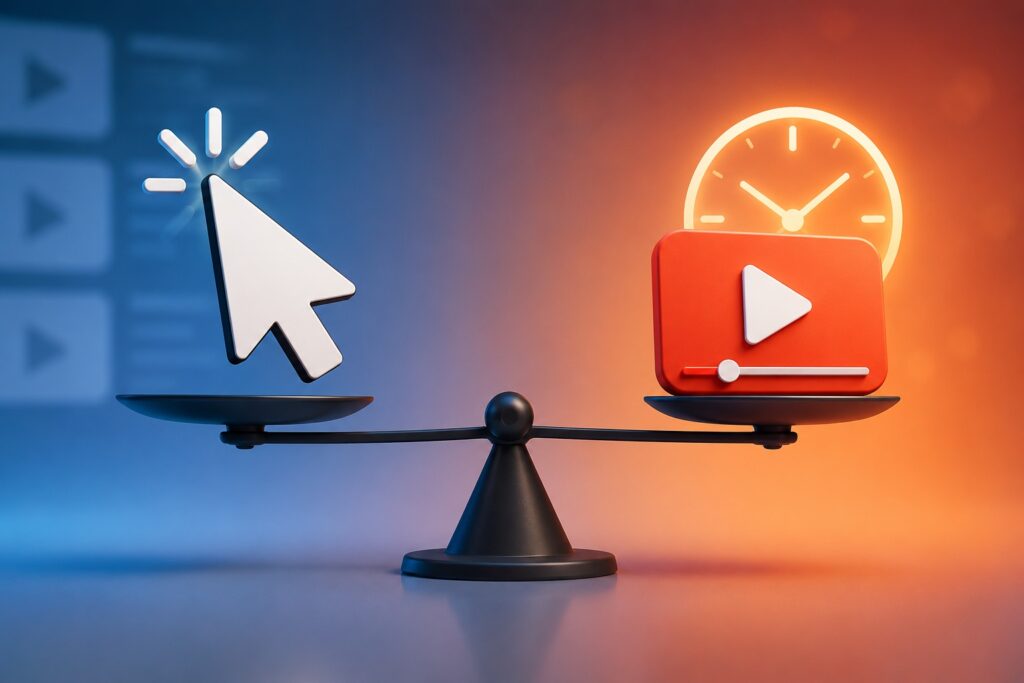
Two metrics usually sit at the center of the debate: Click-Through Rate (CTR) and Watch Time. At first glance, they seem to compete with each other. One measures how many people click. The other measures how long they stay.
But in reality, they are not rivals at all. They are two stages of the same journey.
If you want consistent growth on platforms like YouTube, Facebook, or TikTok, you need to understand not only what these metrics mean—but how they influence each other.
Why Video Metrics Matter More Than Ever
In earlier forms of marketing, success was measured in simple exposure. How many people saw your ad. How many impressions you bought. How many eyeballs were reached.
Video marketing changed that completely.
Today, platforms don’t just care about whether someone saw your content. They care about what people did after seeing it. Did they click? Did they stay? Did they engage?
That shift is why CTR and Watch Time became so important. They are no longer vanity numbers. They are signals that determine whether your video gets pushed to more people or quietly disappears.
What Click-Through Rate Actually Tells You
Click-Through Rate is often misunderstood as a success metric, but it is really a curiosity metric.
It answers one simple question:
“Did your video look interesting enough for someone to click?”
CTR is shaped before anyone even watches your content. It depends on how your video is presented in the feed.
This includes:
- The thumbnail
- The title
- The topic framing
- Audience targeting
- Emotional appeal
A high CTR usually means your packaging works. People see it and think, “I want to know more.”
But CTR alone does not guarantee success. It only gets someone through the door.
What Watch Time Really Measures
Watch Time is where reality shows up.
Unlike CTR, which is about attraction, Watch Time is about retention. It measures whether your content can actually hold attention once someone clicks.
This includes:
- How long people stay
- When they drop off
- Whether they finish the video
- Overall audience retention
Watch Time tells platforms something very important:
“This content delivered on its promise.”
If CTR is the invitation, Watch Time is the experience.
And in most modern algorithms, experience matters more than curiosity.
The Hidden Relationship Between CTR and Watch Time
It’s easy to treat these two metrics separately, but platforms don’t.
They evaluate them together as a sequence:
- A user sees your video (impression)
- They decide whether to click (CTR)
- They decide whether to stay (Watch Time)
If either step fails, the chain breaks.
A video with high CTR but low Watch Time sends a negative signal. It tells the platform that the packaging worked, but the content didn’t deliver.
On the other hand, a video with low CTR but high Watch Time struggles to scale. It performs well only after people find it, but not enough people ever see it.
When CTR Is High but Watch Time Is Weak
This is one of the most common problems in video marketing.
It usually happens when:
- Titles are too sensational
- Thumbnails are misleading
- Expectations are inflated
At first, everything looks promising. Views come in quickly. The CTR looks strong.
But then something changes.
People start leaving within seconds. Retention drops. The algorithm slows down distribution.
What went wrong is simple: the video attracted attention but didn’t sustain it.
Over time, platforms stop recommending it because it fails to satisfy viewers.
When Watch Time Is Strong but CTR Is Low
This is a quieter problem, but just as limiting.
Here, the content itself is solid. People who watch tend to stay. Engagement is strong. The video performs well internally.
But it never gets enough exposure.
Why?
Because the packaging doesn’t trigger curiosity.
Weak thumbnails, unclear titles, or poor positioning can all reduce CTR. And if people don’t click in the first place, even great content stays hidden.
In this case, the video is valuable—but invisible.
So Which Metric Matters More?
If you look at how modern platforms operate, the answer becomes clearer.
Watch Time carries more long-term weight because it reflects satisfaction and content quality.
However, CTR is still essential because it determines whether your content gets tested in the first place.
A simple way to think about it is this:
- CTR opens the door
- Watch Time determines how long you stay inside
One without the other creates imbalance.
How Platforms Actually Evaluate Your Video
Most major platforms don’t look at metrics in isolation. Instead, they evaluate performance in stages.
Stage 1: Exposure and Clicks
Your video is shown to a small audience. The platform measures CTR to see if people are interested.
If CTR is too low, distribution slows immediately.
Stage 2: Engagement and Retention
If people click, the platform watches behavior closely.
- Do they stay?
- Do they leave early?
- Do they watch more content afterward?
This is where Watch Time becomes critical.
Stage 3: Satisfaction Signals
Beyond watch behavior, platforms also track:
- Likes
- Comments
- Shares
- “Not interested” clicks
These signals help refine future recommendations.
Together, these stages decide whether your video grows or fades.
How to Improve Click-Through Rate Naturally
Improving CTR is less about tricks and more about clarity and curiosity.
Strong CTR usually comes from:
- Clear, high-contrast thumbnails
- Titles that create curiosity without confusion
- Topics that match audience intent
- Emotional or outcome-driven framing
The goal is not to exaggerate—but to make people want to understand more.
How to Improve Watch Time Effectively
Watch Time improves when the content itself respects attention.
That means:
- Starting quickly without long introductions
- Delivering value early in the video
- Keeping pacing dynamic
- Avoiding unnecessary filler
- Matching what the title promised
A viewer should never feel like they clicked into something different from what they expected.
The Real Strategy: Balancing Both Metrics
The strongest video marketing systems don’t optimize for CTR or Watch Time alone. They build alignment between them.
When your packaging and your content match, something powerful happens:
- More people click
- More people stay
- The algorithm gains confidence
- Distribution expands
This creates a compounding effect where each new video performs better than the last.
Final Thoughts
Click-Through Rate and Watch Time are often discussed as if one must be more important than the other. But in reality, they are part of the same system.
CTR determines whether your video gets attention.
Watch Time determines whether it deserves more.
If you want sustainable video marketing growth, the goal is not to choose between them—but to build a structure where both naturally improve together.
That’s what separates videos that get a few views from videos that consistently grow over time.
The written content on this page was generated by ChatGPT.