Tag Archives: brand awareness

How to Scale a Successful Video Marketing Campaign Step-by-Step

Video marketing has evolved from a nice addition to a core part of modern digital marketing. Businesses of every size are investing in video because it captures attention, builds trust, and helps customers make buying decisions. However, creating one successful video isn’t enough to generate consistent growth. The real challenge is learning how to scale your video marketing campaign without sacrificing quality, engagement, or return on investment.

Scaling doesn’t simply mean producing more videos. It means creating a repeatable system that allows you to reach more people, generate more leads, and increase conversions while making the best use of your time and budget. Whether you’re a small business owner, marketer, or entrepreneur, following a structured approach will help you expand your video marketing efforts with confidence.
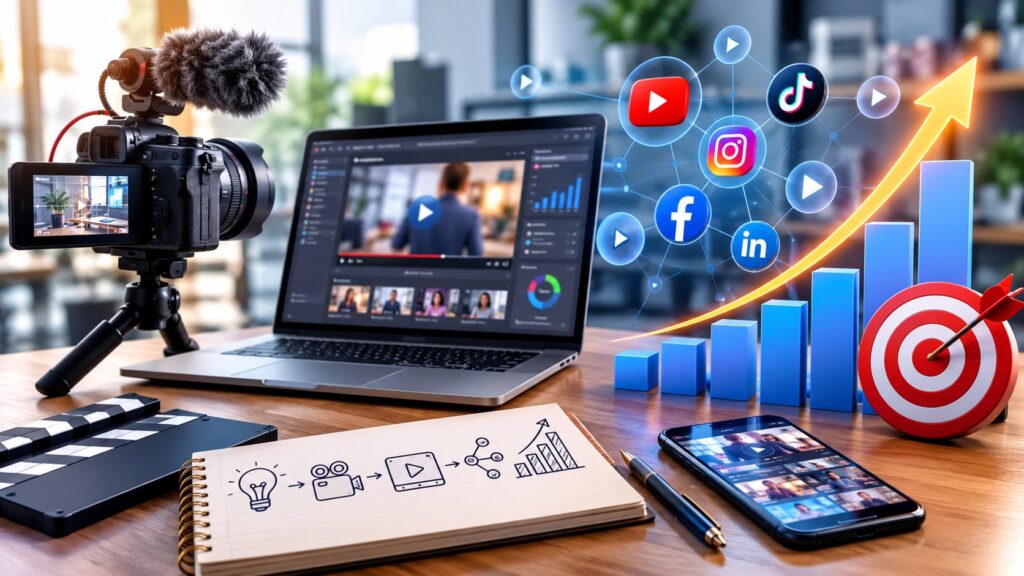
How to Scale a Successful Video Marketing Campaign Step-by-Step
image generated by ChatGPT

Start With a Winning Campaign

Before scaling any campaign, identify what made your original video successful. Expanding a campaign that never delivered results will only increase wasted resources.

Review your best-performing videos and ask yourself:

  • Which videos generated the most views?
  • Which videos kept viewers watching the longest?
  • Which videos produced the most website visits?
  • Which videos generated leads or sales?
  • Which platforms performed best?

Instead of guessing, let your data reveal what resonates with your audience. High-performing videos often have clear messaging, a strong opening, valuable information, and a compelling call to action.

Define Clear Growth Objectives

Scaling works best when you know exactly what you’re trying to accomplish.

Examples of measurable goals include:

  • Increase monthly video views by 50%
  • Double website traffic from video content
  • Generate 100 qualified leads per month
  • Grow YouTube subscribers by 25%
  • Increase product sales through video by 30%

Having measurable objectives helps determine which metrics deserve the most attention throughout your campaign.

Know Your Audience Better Than Ever

One mistake many businesses make is creating videos for everyone. Successful campaigns focus on a clearly defined audience.

Develop detailed customer profiles by considering:

  • Age
  • Occupation
  • Interests
  • Pain points
  • Purchasing behavior
  • Preferred social media platforms
  • Questions customers frequently ask

The better you understand your audience, the easier it becomes to create videos that feel relevant and useful.

Build a Repeatable Video Marketing System

Businesses that consistently publish successful videos rarely create content randomly.

Instead, they develop a repeatable workflow.

A scalable production process often includes:

Research

Find trending industry topics, customer questions, and popular keywords.

Planning

Create monthly content calendars instead of deciding what to publish at the last minute.

Scripting

Use a consistent structure:

  • Hook
  • Problem
  • Solution
  • Proof
  • Call to action

Production

Record multiple videos during one filming session to save time.

Editing

Create reusable templates for:

  • Intro animations
  • Lower thirds
  • End screens
  • Branding elements

This system dramatically increases productivity while maintaining consistency.

Produce Content in Batches

Batch production is one of the most effective ways to scale.

Instead of filming one video every week, dedicate one day each month to recording several videos.

For example:

  • Monday: Research
  • Tuesday: Script writing
  • Wednesday: Filming 8–10 videos
  • Thursday: Editing
  • Friday: Scheduling and publishing

This approach reduces setup time and improves efficiency.

Repurpose Every Video

One long-form video can become dozens of content pieces.

For example, a 15-minute educational video can become:

  • YouTube video
  • Five Instagram Reels
  • Five TikTok videos
  • Multiple Facebook clips
  • Pinterest Idea Pins
  • LinkedIn video posts
  • Blog article
  • Email newsletter
  • Podcast episode
  • Short quotes for social media

Repurposing allows you to maximize the value of every recording session without constantly creating new material.

Optimize Videos for Search Engines

Creating excellent videos is only half the job. People must also be able to find them.

Improve discoverability by optimizing:

Video Titles

Use descriptive titles that naturally include your primary keyword.

Example:

“How to Scale a Successful Video Marketing Campaign Step-by-Step”

Descriptions

Write detailed descriptions explaining what viewers will learn.

Include:

  • Primary keyword
  • Secondary keywords
  • Website links
  • Social media links
  • Relevant timestamps

Tags

Use a combination of:

  • Broad keywords
  • Industry keywords
  • Long-tail phrases
  • Brand keywords

Closed Captions

Captions improve accessibility while giving search engines additional text to understand your content.

Publish Across Multiple Platforms

Scaling requires meeting your audience wherever they spend time.

Instead of relying on one platform, distribute content across:

  • YouTube
  • Facebook
  • Instagram
  • TikTok
  • LinkedIn
  • Pinterest
  • X
  • Company website
  • Email newsletters

Customize each version to match platform requirements rather than uploading identical copies everywhere.

Develop a Consistent Publishing Schedule

Consistency builds audience trust.

Whether you publish:

  • Two videos each week
  • Three Shorts daily
  • One educational video every Friday

Stick to a predictable schedule.

Consistency often outperforms occasional bursts of content followed by long periods of inactivity.

Create Content Around Customer Questions

One of the easiest ways to produce endless video ideas is by answering customer questions.

Common examples include:

  • How much does this service cost?
  • Which product is right for me?
  • What mistakes should I avoid?
  • How long does the process take?
  • What happens after purchase?

Educational videos establish authority while improving search visibility.

Expand Successful Topics

If one topic performs well, build an entire content series around it.

For example, if “Video SEO Tips” attracts thousands of viewers, create related videos such as:

  • Beginner’s Guide to Video SEO
  • Advanced Video SEO Strategies
  • Common Video SEO Mistakes
  • YouTube Ranking Factors
  • Video Metadata Best Practices

This topical clustering helps search engines recognize your expertise.

Invest in Better Equipment Strategically

Scaling doesn’t require buying the most expensive camera.

Prioritize upgrades that noticeably improve quality:

  • Good microphone
  • Proper lighting
  • Stable tripod
  • External storage
  • Editing software

Excellent audio often has a greater impact on viewer satisfaction than ultra-high-resolution video.

Automate Repetitive Tasks

Automation saves hours every week.

Consider automating:

  • Social media scheduling
  • Email notifications
  • Video publishing
  • Caption generation
  • Analytics reporting
  • Thumbnail templates

These efficiencies allow you to spend more time creating valuable content.

Build a Video Content Library

Organize every project into searchable folders.

Categorize assets by:

  • Topic
  • Product
  • Customer stage
  • Industry
  • Campaign
  • Platform

A well-organized library speeds up future production and simplifies content repurposing.

Collaborate With Experts

Partnerships can dramatically expand your reach.

Consider working with:

  • Industry influencers
  • Podcast hosts
  • Business partners
  • Customers
  • Employees
  • Content creators

Guest appearances introduce your brand to new audiences while increasing credibility.

Use Paid Promotion Wisely

Organic reach builds long-term authority, but paid advertising accelerates growth.

Promote videos that already perform well organically.

Focus on:

  • YouTube Ads
  • Facebook Video Ads
  • Instagram Ads
  • LinkedIn Sponsored Videos

Avoid spending heavily on videos that have not demonstrated audience interest.

Monitor Performance Regularly

Scaling successfully requires continuous optimization.

Track important metrics such as:

  • Views
  • Watch time
  • Audience retention
  • Click-through rate
  • Engagement rate
  • Website traffic
  • Leads generated
  • Conversion rate
  • Cost per acquisition
  • Return on investment

These insights reveal what deserves additional investment.

Test, Learn, and Improve

No campaign is perfect from the beginning.

Continuously experiment with:

  • Video length
  • Thumbnails
  • Titles
  • Opening hooks
  • Calls to action
  • Publishing times
  • Video formats

Small improvements made consistently often produce significant long-term growth.

Build a Recognizable Brand

As your campaign grows, maintain consistent branding.

Keep your:

  • Logo
  • Colors
  • Fonts
  • Intro
  • Outro
  • Tone of voice
  • Thumbnail style

Consistency helps viewers instantly recognize your content.

Turn Viewers Into Customers

Scaling views means little without conversions.

Every video should guide viewers toward a logical next step.

Examples include:

  • Subscribe
  • Download a free guide
  • Request a consultation
  • Start a free trial
  • Visit your website
  • Purchase a product
  • Join your email list

A clear call to action transforms attention into measurable business results.

Continue Learning From Your Audience

Successful video marketers never stop listening.

Read comments, conduct surveys, monitor reviews, and study analytics to discover what your audience truly wants. The more your content aligns with viewer needs, the easier it becomes to scale without losing engagement.

source: Video Made Simple by Boxset Media

Final Thoughts

Scaling a successful video marketing campaign is not about creating an endless stream of videos. It is about developing efficient systems, understanding your audience, optimizing content for search, distributing videos across multiple platforms, and continually improving based on performance data.

Businesses that approach video marketing strategically rather than randomly are better positioned to build authority, generate qualified leads, and achieve sustainable growth. Start by refining one successful campaign, build repeatable processes, and expand thoughtfully. Over time, these incremental improvements can transform video marketing into one of your most valuable and profitable digital marketing assets.

The written content on this page was generated by ChatGPT.

Explainer Videos vs Product Demo Videos: Which One Should You Use First?

Most businesses don’t struggle with whether video marketing works. That part is already settled. The real challenge shows up much earlier—choosing what kind of video to start with.

Two of the most commonly used formats are explainer videos and product demo videos. On the surface, they might look similar. Both are short, both are promotional, and both are used to increase sales. But in practice, they serve very different roles in your marketing strategy.

So the real question is not just what they are—but which one actually makes sense to create first when you’re starting from zero or building a new campaign?

To answer that properly, it helps to understand how each one behaves in the real world.

Explainer Videos vs Product Demo Videos: Which One Should You Use First?

What an Explainer Video Actually Does for Your Business

An explainer video is usually the first “conversation” your business has with a potential customer.

At this stage, people don’t really know you yet. They may have landed on your website, seen a social post, or clicked an ad out of curiosity. They are not looking for deep technical details. They are still trying to answer something very basic:

“What is this, and why should I care?”

That’s exactly where explainer videos perform best.

Instead of focusing on features or step-by-step usage, they focus on clarity. They take something that might be complicated—like a service, software, or business model—and turn it into something easy to understand in under two minutes.

Where explainer videos really shine

They are especially effective when:

  • Your product or service is new to the market
  • Your idea needs context before it makes sense
  • Your audience is cold and unfamiliar with your brand
  • You need to simplify something technical or abstract

A good explainer video removes confusion. And in marketing, clarity often comes before interest.

For example, if a company offers a subscription-based cleaning service, most people won’t immediately understand how scheduling, pricing, or recurring visits work. An explainer video can walk through that entire experience in a simple story, helping the viewer understand the value without effort.

That “instant understanding” is what makes explainer videos powerful at the beginning of a customer journey.


What a Product Demo Video Actually Focuses On

A product demo video comes in at a very different stage.

By the time someone is watching a demo, they already have some level of interest. They are no longer asking what the product is. Instead, they are asking something more practical:

“How does it actually work, and will it solve my problem?”

This is where detail matters.

Unlike explainer videos, demos don’t simplify the idea—they prove it. They show the product in action, often step by step, so the viewer can visualize exactly what owning or using it would feel like.

Where product demo videos perform best

They are most effective when:

  • Your audience already understands the product category
  • You’re targeting warm leads or returning visitors
  • The purchase decision depends on features or usability
  • You need to reduce hesitation before buying

For example, if you’re selling a project management tool, the audience likely already knows what such tools do. What they need now is confidence. A demo video showing task creation, team collaboration, and workflow automation helps remove doubt and makes the decision easier.

In other words, demos don’t introduce—they reassure.


The Real Difference Between the Two

Although both formats sit under video marketing, they operate at different stages of persuasion.

Here’s a simple way to think about it:

  • Explainer videos build understanding
  • Product demos build confidence

That difference changes everything.

Explainer videos are emotional and conceptual. They focus on the “why.”
Product demos are logical and functional. They focus on the “how.”

One prepares the audience. The other convinces them.


So Which One Should You Create First?

If you’re just starting out, the safest and most effective answer is usually this:

Start with an explainer video.

That might feel less exciting, especially if you’re eager to show off your product. But in most cases, skipping the explainer stage creates a hidden problem—people don’t fully understand what you do, which means they don’t engage deeply enough to care about the demo.

There are a few reasons why explainer videos typically come first:

1. Most audiences need context before details

If someone doesn’t fully understand your offer, showing them features won’t help. It only adds more confusion.

2. Cold traffic needs simplicity

People seeing your brand for the first time are not ready for technical explanations. They need a clear message before anything else.

3. It forces you to refine your message

Creating an explainer video forces you to simplify your business into its core idea. That clarity improves everything else—ads, landing pages, and even sales conversations.


When a Product Demo Should Come First Instead

There are situations where starting with a demo actually makes more sense.

For example:

1. Your product category is already familiar

If people already understand what your product is (like smartphones, apps, or tools), you don’t need to explain the concept—you just need to show what makes yours better.

2. You already have warm traffic

If visitors are already aware of your brand, a demo becomes more powerful than another introduction.

3. Your focus is direct conversion

If your goal is immediate sales rather than awareness, demos can push people closer to purchase faster.


The Most Effective Strategy: Use Both in Sequence

The real strength of video marketing comes when you stop thinking in terms of “which one is better” and start thinking in terms of “what order makes sense.”

A strong funnel often looks like this:

Stage 1: Awareness

  • Explainer videos
  • Short brand introductions
  • Educational content

Stage 2: Consideration

  • Product demos
  • Tutorials
  • Feature breakdowns

Stage 3: Decision

  • Testimonials
  • Case studies
  • Reviews

When structured this way, each video has a clear job. Nothing overlaps, and nothing feels wasted.


A Simple Real-World Example

Imagine a small business offering an online fitness coaching app.

At the beginning, most people don’t know what makes it different from hundreds of other fitness apps. An explainer video helps introduce the concept, the benefits, and the transformation it offers.

Once that interest is built, a product demo shows how the app actually works—tracking workouts, logging meals, and following guided programs.

The result is a smoother customer journey. People understand the idea first, then see the proof, and finally feel comfortable committing.


A Mistake Many Businesses Make

One of the most common mistakes is skipping the explainer stage entirely and jumping straight into product demos.

On paper, it sounds logical. If you show the product, people should buy it. But in reality, it often fails because the viewer is still trying to figure out the bigger picture.

Without that foundation, even a great demo can feel irrelevant.

source: XPLAI

Final Takeaway

There is no universal winner between explainer videos and product demo videos. The right choice depends entirely on where your audience is in their journey.

But as a general rule:

  • Start with an explainer video when you need to build awareness and clarity
  • Use a product demo video when you need to build confidence and drive decisions
  • Combine both when you want a complete, structured marketing system

When used in the right order, these two video types don’t compete with each other—they support each other.

And that combination is often what separates average video marketing from campaigns that actually convert.

The written content on this page was generated by ChatGPT.

How Consistency in Video Marketing Builds Audience Trust

Most businesses don’t struggle with creating video content once. The real challenge is showing up again and again with content that people can rely on. In video marketing, consistency isn’t just a scheduling habit—it becomes part of how your audience judges your credibility.

When people repeatedly see your brand delivering useful, relevant videos, something important happens: they stop seeing you as a random content creator and start seeing you as a dependable source.

Trust is not built instantly. It develops slowly, through repeated exposure and predictable value.

How Consistency in Video Marketing Builds Audience Trust

Why Consistency Matters More Than One Viral Video

It’s easy to get excited about the idea of going viral. A single video can bring thousands of views overnight. But what happens after that moment fades?

In most cases, nothing lasting.

Virality creates attention, but consistency creates relationships. And relationships are what build trust.

When a viewer sees your content regularly, your brand becomes familiar. That familiarity removes uncertainty. And when uncertainty drops, trust increases naturally.

Think about the brands or creators you trust most. It’s rarely because of one video—it’s because they show up consistently over time.


Familiarity Is the First Step Toward Trust

Before someone trusts your business, they need to recognize it. Familiarity is the bridge between awareness and trust.

Every time your audience sees your videos, they are quietly learning:

  • What your brand stands for
  • How you communicate
  • What value you offer
  • Whether you are reliable

Even if they don’t engage immediately, the repetition is still working in the background. Over time, your presence becomes part of their routine.

That repeated exposure is what turns a cold viewer into a warm lead.


Consistency Builds the Image of Reliability

A business that posts regularly sends a silent but powerful message: “We are active, stable, and committed.”

On the other hand, irregular posting can create doubt. If someone visits your page and sees long gaps between videos, they may question whether the business is still active or relevant.

Consistency removes that doubt.

Even simple, steady uploads—once a week or twice a month—signal that your business is engaged and paying attention. In the eyes of your audience, that reliability matters more than high production value alone.


Authority Is Built Through Repetition, Not One-Off Efforts

No one becomes an authority in a niche overnight. Authority is built through accumulation.

When you consistently publish helpful videos—tutorials, explanations, insights, or answers—you begin to occupy mental space in your audience’s mind.

Eventually, people start associating your brand with expertise.

For example, if someone repeatedly finds your videos helpful when searching for solutions in your industry, they will naturally begin to view you as a trusted voice.

Search engines also recognize this pattern. Regular content signals activity, relevance, and topical depth, all of which support better visibility over time.


Algorithms Reward Consistent Creators

Beyond human psychology, consistency also matters for platform algorithms.

YouTube, Facebook, Instagram, and other platforms are designed to promote active creators. When you upload regularly, you give the algorithm more data about your content and audience.

This often leads to:

  • More recommendations
  • Higher visibility in search results
  • Increased watch time distribution
  • Stronger engagement signals

In simple terms, consistency improves both trust with people and trust with platforms.


Emotional Trust Develops Over Time

Trust is not only logical—it’s emotional.

When people consistently see your face, hear your voice, or experience your content style, they begin forming a connection with your brand.

That emotional familiarity matters more than many businesses realize.

At some point, your audience stops asking, “Who are you?” and starts thinking, “I know this brand. I trust what they share.”

This emotional shift is what turns viewers into loyal customers.


What Real Consistency Looks Like in Video Marketing

Consistency does not mean posting every day or burning yourself out.

It means choosing a schedule you can realistically maintain over the long term.

Some practical examples include:

  • One well-planned video per week
  • Two videos per month with supporting short clips
  • Weekly short-form content combined with monthly in-depth videos

The important part is predictability. Your audience should know that you will show up regularly.


Mistakes That Break Consistency and Trust

Many businesses struggle not because they lack ideas, but because they lose momentum. Here are a few common issues:

Starting strong, then disappearing

A burst of early content followed by silence creates confusion and weakens trust instead of building it.

Posting without a clear direction

Random content makes it hard for audiences to understand your value, which reduces long-term engagement.

Focusing only on quantity

More videos do not always mean better results. Low-value content can damage credibility.


How to Maintain Long-Term Consistency

Staying consistent becomes much easier with structure.

Plan your content in advance

A simple content calendar helps you avoid last-minute decisions and keeps your ideas organized.

Batch your production

Filming multiple videos in one session reduces pressure and ensures you always have content ready.

Repurpose your videos

One video can become:

  • Short clips for social media
  • Blog content
  • Email content
  • Educational posts

Focus on evergreen topics

Content that stays relevant over time continues to bring value long after it is published.


The Long-Term Impact of Consistent Video Marketing

The real power of consistency is that its results compound.

At first, progress may feel slow. But over time, consistent video marketing builds a strong foundation of:

  • Brand recognition
  • Audience trust
  • Organic traffic growth
  • Higher conversion rates
  • Stronger customer loyalty

Each video adds another layer to your brand’s digital presence. Eventually, your content works for you even when you’re not actively promoting it.

source: @omnivistapro

Final Thoughts

Consistency in video marketing is not about being perfect or producing endless content. It’s about reliability, structure, and long-term commitment.

When your audience knows they can expect value from you regularly, trust develops naturally. And once trust is established, every other part of your marketing becomes easier.

In the end, businesses that win with video aren’t always the loudest or most viral—they are the ones that keep showing up.

The written content on this page was generated by ChatGPT.