Tag Archives: click through rate

Click-Through Rate vs Watch Time: What Matters More in Video Marketing

Video marketing has become one of the most powerful ways to grow a business online, but it has also become one of the most misunderstood. Many creators obsess over numbers without fully understanding what those numbers actually represent.

Two metrics usually sit at the center of the debate: Click-Through Rate (CTR) and Watch Time. At first glance, they seem to compete with each other. One measures how many people click. The other measures how long they stay.

But in reality, they are not rivals at all. They are two stages of the same journey.

If you want consistent growth on platforms like YouTube, Facebook, or TikTok, you need to understand not only what these metrics mean—but how they influence each other.
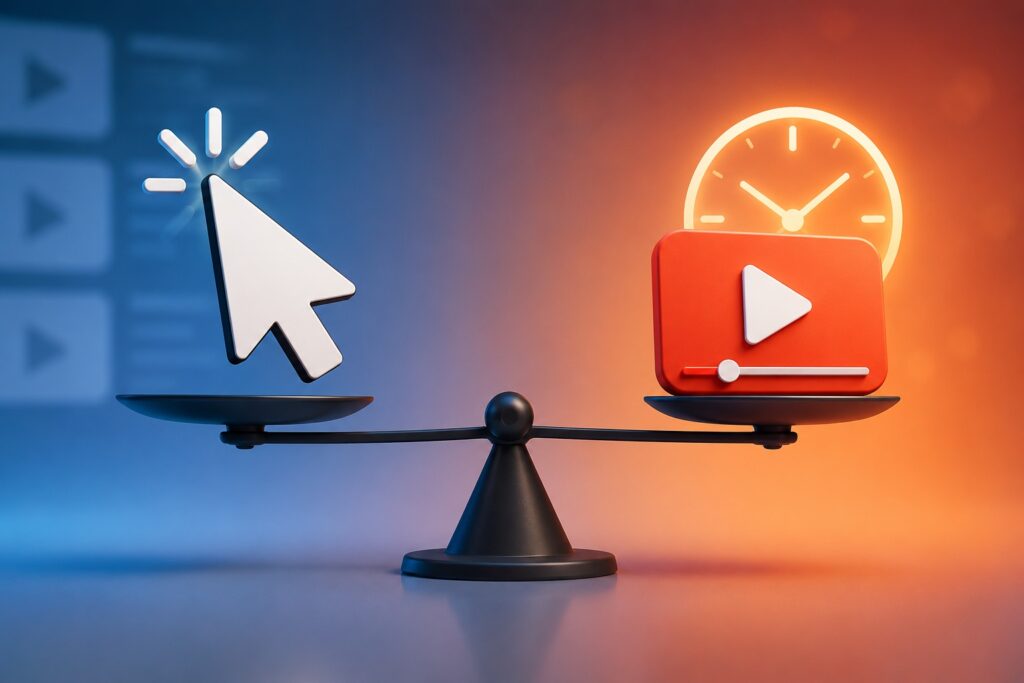
Click-Through Rate vs Watch Time: What Matters More in Video Marketing
Generated by ChatGPT

Why Video Metrics Matter More Than Ever

In earlier forms of marketing, success was measured in simple exposure. How many people saw your ad. How many impressions you bought. How many eyeballs were reached.

Video marketing changed that completely.

Today, platforms don’t just care about whether someone saw your content. They care about what people did after seeing it. Did they click? Did they stay? Did they engage?

That shift is why CTR and Watch Time became so important. They are no longer vanity numbers. They are signals that determine whether your video gets pushed to more people or quietly disappears.


What Click-Through Rate Actually Tells You

Click-Through Rate is often misunderstood as a success metric, but it is really a curiosity metric.

It answers one simple question:

“Did your video look interesting enough for someone to click?”

CTR is shaped before anyone even watches your content. It depends on how your video is presented in the feed.

This includes:

  • The thumbnail
  • The title
  • The topic framing
  • Audience targeting
  • Emotional appeal

A high CTR usually means your packaging works. People see it and think, “I want to know more.”

But CTR alone does not guarantee success. It only gets someone through the door.


What Watch Time Really Measures

Watch Time is where reality shows up.

Unlike CTR, which is about attraction, Watch Time is about retention. It measures whether your content can actually hold attention once someone clicks.

This includes:

  • How long people stay
  • When they drop off
  • Whether they finish the video
  • Overall audience retention

Watch Time tells platforms something very important:

“This content delivered on its promise.”

If CTR is the invitation, Watch Time is the experience.

And in most modern algorithms, experience matters more than curiosity.


The Hidden Relationship Between CTR and Watch Time

It’s easy to treat these two metrics separately, but platforms don’t.

They evaluate them together as a sequence:

  1. A user sees your video (impression)
  2. They decide whether to click (CTR)
  3. They decide whether to stay (Watch Time)

If either step fails, the chain breaks.

A video with high CTR but low Watch Time sends a negative signal. It tells the platform that the packaging worked, but the content didn’t deliver.

On the other hand, a video with low CTR but high Watch Time struggles to scale. It performs well only after people find it, but not enough people ever see it.


When CTR Is High but Watch Time Is Weak

This is one of the most common problems in video marketing.

It usually happens when:

  • Titles are too sensational
  • Thumbnails are misleading
  • Expectations are inflated

At first, everything looks promising. Views come in quickly. The CTR looks strong.

But then something changes.

People start leaving within seconds. Retention drops. The algorithm slows down distribution.

What went wrong is simple: the video attracted attention but didn’t sustain it.

Over time, platforms stop recommending it because it fails to satisfy viewers.


When Watch Time Is Strong but CTR Is Low

This is a quieter problem, but just as limiting.

Here, the content itself is solid. People who watch tend to stay. Engagement is strong. The video performs well internally.

But it never gets enough exposure.

Why?

Because the packaging doesn’t trigger curiosity.

Weak thumbnails, unclear titles, or poor positioning can all reduce CTR. And if people don’t click in the first place, even great content stays hidden.

In this case, the video is valuable—but invisible.


So Which Metric Matters More?

If you look at how modern platforms operate, the answer becomes clearer.

Watch Time carries more long-term weight because it reflects satisfaction and content quality.

However, CTR is still essential because it determines whether your content gets tested in the first place.

A simple way to think about it is this:

  • CTR opens the door
  • Watch Time determines how long you stay inside

One without the other creates imbalance.


How Platforms Actually Evaluate Your Video

Most major platforms don’t look at metrics in isolation. Instead, they evaluate performance in stages.

Stage 1: Exposure and Clicks

Your video is shown to a small audience. The platform measures CTR to see if people are interested.

If CTR is too low, distribution slows immediately.


Stage 2: Engagement and Retention

If people click, the platform watches behavior closely.

  • Do they stay?
  • Do they leave early?
  • Do they watch more content afterward?

This is where Watch Time becomes critical.


Stage 3: Satisfaction Signals

Beyond watch behavior, platforms also track:

  • Likes
  • Comments
  • Shares
  • “Not interested” clicks

These signals help refine future recommendations.

Together, these stages decide whether your video grows or fades.


How to Improve Click-Through Rate Naturally

Improving CTR is less about tricks and more about clarity and curiosity.

Strong CTR usually comes from:

  • Clear, high-contrast thumbnails
  • Titles that create curiosity without confusion
  • Topics that match audience intent
  • Emotional or outcome-driven framing

The goal is not to exaggerate—but to make people want to understand more.


How to Improve Watch Time Effectively

Watch Time improves when the content itself respects attention.

That means:

  • Starting quickly without long introductions
  • Delivering value early in the video
  • Keeping pacing dynamic
  • Avoiding unnecessary filler
  • Matching what the title promised

A viewer should never feel like they clicked into something different from what they expected.


The Real Strategy: Balancing Both Metrics

The strongest video marketing systems don’t optimize for CTR or Watch Time alone. They build alignment between them.

When your packaging and your content match, something powerful happens:

  • More people click
  • More people stay
  • The algorithm gains confidence
  • Distribution expands

This creates a compounding effect where each new video performs better than the last.

source: Nick Nimmin

Final Thoughts

Click-Through Rate and Watch Time are often discussed as if one must be more important than the other. But in reality, they are part of the same system.

CTR determines whether your video gets attention.
Watch Time determines whether it deserves more.

If you want sustainable video marketing growth, the goal is not to choose between them—but to build a structure where both naturally improve together.

That’s what separates videos that get a few views from videos that consistently grow over time.

The written content on this page was generated by ChatGPT.

How to Measure Success in Your First Video Marketing Campaign

Starting your first video marketing campaign often feels like a major milestone. You plan the script, shoot the footage, edit everything together, and finally publish it. There is a sense of accomplishment when the video goes live.

But after that initial excitement fades, a more important question appears. How do you actually know if it worked?

A video can look polished and still fail to deliver results. At the same time, a simple video shot on a phone can quietly bring in customers, leads, and real business growth. The difference is not always in production quality—it is in how success is measured and interpreted.

Understanding how to evaluate performance early on helps you avoid guesswork and gives you a clearer path for improvement with every video you create.

How to Measure Success in Your First Video Marketing Campaign
image generate by ChatGPT

Why Measurement Matters More Than the Video Itself

Many beginners focus heavily on making the video look perfect. Lighting, editing, background music, and transitions all take priority. While these things matter, they do not guarantee results.

What truly determines success is how your audience responds after watching.

When you measure properly, you begin to understand:

  • What actually holds attention
  • What causes viewers to lose interest
  • What motivates people to take action
  • Which content style fits your audience best

Without measurement, you are simply publishing content and hoping for the best. With measurement, you are building a strategy that improves over time.


Start by Defining What Success Means for You

Before checking any numbers, it is important to step back and ask a simple question: what is this video supposed to achieve?

Different businesses use video for different reasons.

Some want visibility and awareness, especially if they are just starting out. Others are focused on getting inquiries, calls, or direct sales. Some simply want to educate their audience and build trust over time.

A few common goals include:

  • Getting more people to recognize your brand
  • Driving traffic to your website
  • Generating leads or inquiries
  • Increasing product or service sales
  • Building audience engagement

The key is to choose one primary goal for each video. Trying to measure everything at once often leads to confusion.


Views Are Only the Starting Point

One of the first numbers people look at is views. It is easy to understand and gives a quick sense of reach.

However, views alone do not tell the full story.

A video might get thousands of views simply because it was shown to the right audience at the right time. But if those viewers do not stay, interact, or take action, the video is not truly effective.

Instead of focusing only on how many people clicked play, it is more useful to look at what happens after they start watching.


Watch Time Shows Real Interest

Watch time is one of the strongest indicators of content quality.

It tells you how long people are actually paying attention to your video. A high watch time usually means your message is clear, engaging, and relevant to the viewer.

If people stop watching early, that is also important information. It could mean:

  • The introduction is too slow
  • The message is not clear enough
  • The video does not match audience expectations

Improving watch time is often more valuable than increasing views, because it signals genuine interest.


Audience Retention Reveals Where You Lose People

While watch time gives an overall picture, audience retention shows something more detailed.

It helps you understand exactly where viewers stop watching. This can reveal patterns that are easy to miss otherwise.

For example:

  • If many viewers leave in the first 10 seconds, your intro may need improvement
  • If there is a drop in the middle, the content may be too complex or slow
  • If viewers stay until the end, your structure is likely working well

This type of insight allows you to refine your videos step by step instead of guessing what went wrong.


Engagement Shows Emotional Connection

Engagement is where you start to see how people feel about your content.

When viewers like, comment, or share your video, it shows they are not just watching—they are reacting.

Each type of engagement gives different insight:

  • Likes suggest approval or agreement
  • Comments show interest or curiosity
  • Shares indicate strong value or relatability
  • Saves suggest usefulness or reference value

High engagement often leads to better reach, because platforms tend to promote content that keeps people interacting.


Click-Through Rate Tells You If People Take Action

If your video includes a link, offer, or next step, click-through rate becomes an important measure.

It shows how many viewers moved from watching to doing something.

A low click-through rate does not always mean the video is bad. It may simply mean:

  • The call-to-action was unclear
  • The timing of the CTA was off
  • The offer was not strong enough

Sometimes a small adjustment in wording or placement can significantly improve results.


Conversions Show Real Business Impact

Ultimately, the most meaningful measure of success is whether the video helped your business grow.

Conversions can include things like:

  • Filling out a contact form
  • Making a purchase
  • Booking a service
  • Signing up for a newsletter
  • Making a phone call

This is where video marketing becomes more than content creation. It becomes a business tool.

Tracking conversions often requires analytics tools or tracking links, but it is worth the effort because it connects your video directly to real outcomes.


Comparing Platforms Gives You Direction

Not every platform will perform the same way. A video that works well on one platform may perform differently on another.

By comparing results, you can learn:

  • Where your audience is most active
  • Which platform brings better engagement
  • Where conversions are strongest

This helps you focus your energy instead of spreading your content too thin across multiple channels.


Understanding Return on Investment

If you spent money producing or promoting your video, it is important to understand what you gained in return.

Return on investment is not always just financial. It can also include:

  • New leads
  • Increased website traffic
  • Improved brand visibility
  • Higher engagement rates

A simple way to think about it is whether the value you gained is greater than what you spent.

Even small wins can justify continuing your video strategy.


Use What You Learn to Improve the Next Video

The most important part of measuring success is not the report itself—it is what you do with it.

Every video you publish gives you new information about your audience. Over time, patterns start to appear. You begin to see what works and what does not.

This allows you to improve:

  • Video length
  • Messaging style
  • Visual presentation
  • Calls to action
  • Target audience focus

Instead of starting from scratch each time, you are building on experience. That is where real growth happens.

source: Semrush

Final Thoughts

Measuring success in your first video marketing campaign is not about chasing big numbers. It is about understanding behavior, learning from it, and making better decisions moving forward.

When you focus on meaningful metrics like watch time, engagement, and conversions, you move away from guesswork and toward a more intentional strategy.

The goal is not just to create videos. The goal is to create videos that improve with every attempt and contribute directly to your business growth.

The written content on this page was generated by ChatGPT.