Most businesses don’t struggle with whether video marketing works. That part is already settled. The real challenge shows up much earlier—choosing what kind of video to start with.
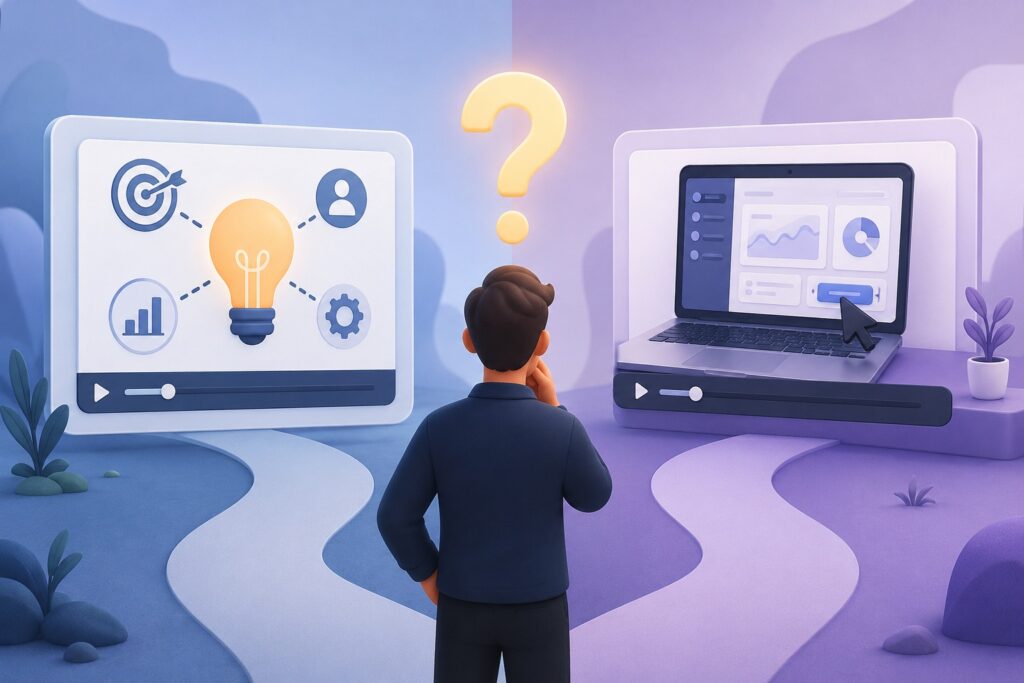
Two of the most commonly used formats are explainer videos and product demo videos. On the surface, they might look similar. Both are short, both are promotional, and both are used to increase sales. But in practice, they serve very different roles in your marketing strategy.
So the real question is not just what they are—but which one actually makes sense to create first when you’re starting from zero or building a new campaign?
To answer that properly, it helps to understand how each one behaves in the real world.
What an Explainer Video Actually Does for Your Business
An explainer video is usually the first “conversation” your business has with a potential customer.
At this stage, people don’t really know you yet. They may have landed on your website, seen a social post, or clicked an ad out of curiosity. They are not looking for deep technical details. They are still trying to answer something very basic:
“What is this, and why should I care?”
That’s exactly where explainer videos perform best.
Instead of focusing on features or step-by-step usage, they focus on clarity. They take something that might be complicated—like a service, software, or business model—and turn it into something easy to understand in under two minutes.
Where explainer videos really shine
They are especially effective when:
- Your product or service is new to the market
- Your idea needs context before it makes sense
- Your audience is cold and unfamiliar with your brand
- You need to simplify something technical or abstract
A good explainer video removes confusion. And in marketing, clarity often comes before interest.
For example, if a company offers a subscription-based cleaning service, most people won’t immediately understand how scheduling, pricing, or recurring visits work. An explainer video can walk through that entire experience in a simple story, helping the viewer understand the value without effort.
That “instant understanding” is what makes explainer videos powerful at the beginning of a customer journey.
What a Product Demo Video Actually Focuses On
A product demo video comes in at a very different stage.
By the time someone is watching a demo, they already have some level of interest. They are no longer asking what the product is. Instead, they are asking something more practical:
“How does it actually work, and will it solve my problem?”
This is where detail matters.
Unlike explainer videos, demos don’t simplify the idea—they prove it. They show the product in action, often step by step, so the viewer can visualize exactly what owning or using it would feel like.
Where product demo videos perform best
They are most effective when:
- Your audience already understands the product category
- You’re targeting warm leads or returning visitors
- The purchase decision depends on features or usability
- You need to reduce hesitation before buying
For example, if you’re selling a project management tool, the audience likely already knows what such tools do. What they need now is confidence. A demo video showing task creation, team collaboration, and workflow automation helps remove doubt and makes the decision easier.
In other words, demos don’t introduce—they reassure.
The Real Difference Between the Two
Although both formats sit under video marketing, they operate at different stages of persuasion.
Here’s a simple way to think about it:
- Explainer videos build understanding
- Product demos build confidence
That difference changes everything.
Explainer videos are emotional and conceptual. They focus on the “why.”
Product demos are logical and functional. They focus on the “how.”
One prepares the audience. The other convinces them.
So Which One Should You Create First?
If you’re just starting out, the safest and most effective answer is usually this:
Start with an explainer video.
That might feel less exciting, especially if you’re eager to show off your product. But in most cases, skipping the explainer stage creates a hidden problem—people don’t fully understand what you do, which means they don’t engage deeply enough to care about the demo.
There are a few reasons why explainer videos typically come first:
1. Most audiences need context before details
If someone doesn’t fully understand your offer, showing them features won’t help. It only adds more confusion.
2. Cold traffic needs simplicity
People seeing your brand for the first time are not ready for technical explanations. They need a clear message before anything else.
3. It forces you to refine your message
Creating an explainer video forces you to simplify your business into its core idea. That clarity improves everything else—ads, landing pages, and even sales conversations.
When a Product Demo Should Come First Instead
There are situations where starting with a demo actually makes more sense.
For example:
1. Your product category is already familiar
If people already understand what your product is (like smartphones, apps, or tools), you don’t need to explain the concept—you just need to show what makes yours better.
2. You already have warm traffic
If visitors are already aware of your brand, a demo becomes more powerful than another introduction.
3. Your focus is direct conversion
If your goal is immediate sales rather than awareness, demos can push people closer to purchase faster.
The Most Effective Strategy: Use Both in Sequence
The real strength of video marketing comes when you stop thinking in terms of “which one is better” and start thinking in terms of “what order makes sense.”
A strong funnel often looks like this:
Stage 1: Awareness
- Explainer videos
- Short brand introductions
- Educational content
Stage 2: Consideration
- Product demos
- Tutorials
- Feature breakdowns
Stage 3: Decision
- Testimonials
- Case studies
- Reviews
When structured this way, each video has a clear job. Nothing overlaps, and nothing feels wasted.
A Simple Real-World Example
Imagine a small business offering an online fitness coaching app.
At the beginning, most people don’t know what makes it different from hundreds of other fitness apps. An explainer video helps introduce the concept, the benefits, and the transformation it offers.
Once that interest is built, a product demo shows how the app actually works—tracking workouts, logging meals, and following guided programs.
The result is a smoother customer journey. People understand the idea first, then see the proof, and finally feel comfortable committing.
A Mistake Many Businesses Make
One of the most common mistakes is skipping the explainer stage entirely and jumping straight into product demos.
On paper, it sounds logical. If you show the product, people should buy it. But in reality, it often fails because the viewer is still trying to figure out the bigger picture.
Without that foundation, even a great demo can feel irrelevant.
Final Takeaway
There is no universal winner between explainer videos and product demo videos. The right choice depends entirely on where your audience is in their journey.
But as a general rule:
- Start with an explainer video when you need to build awareness and clarity
- Use a product demo video when you need to build confidence and drive decisions
- Combine both when you want a complete, structured marketing system
When used in the right order, these two video types don’t compete with each other—they support each other.
And that combination is often what separates average video marketing from campaigns that actually convert.
The written content on this page was generated by ChatGPT.