Tag Archives: testimonial videos

Why Testimonial Videos Are One of the Most Powerful Marketing Tools

Most businesses say the same thing: “We’re the best,” “We deliver quality,” “We care about our customers.” The problem is, those claims don’t mean much on their own anymore. People hear them all the time, across every industry, from every competitor.

What actually breaks through that noise is something far more grounded—real customers sharing real experiences in their own words. That’s where testimonial videos come in, and why they’ve become one of the most effective tools in modern marketing.

Unlike polished advertisements, testimonial videos don’t try to convince in a traditional sense. Instead, they show proof. And in today’s environment, proof matters more than promotion.

Why Testimonial Videos Are One of the Most Powerful Marketing Tools
image generate by ChatGPT

Why People Trust Other People More Than Brands

There’s a simple reason testimonial videos work so well: people trust other people more than they trust companies.

When someone is deciding whether to buy a product or hire a service, they naturally look for reassurance. They want to know if it has worked for someone else, especially someone who seems relatable.

This is where psychology plays a big role. Humans rely heavily on social proof when making decisions. If others have had a good experience, it reduces uncertainty. It makes the choice feel safer.

A written review can help with that, but video goes further. When you see a real person speaking, you pick up on details that text cannot carry—tone, emotion, hesitation, excitement, confidence. All of these signals shape how believable the message feels.


The Difference Between Hearing It and Seeing It

There’s a major gap between reading a testimonial and watching one.

A written review might say:
“Great service, highly recommended.”

But a video shows someone explaining:
what problem they had,
why they were frustrated,
how they discovered the solution,
and what actually changed afterward.

That narrative structure matters. People don’t just want praise—they want context. They want to understand the journey.

Video makes that journey visible. It adds facial expressions, voice tone, and real reactions. Those small details make the story feel less like marketing and more like a conversation.


Why Testimonial Videos Build Trust Faster Than Anything Else

Trust usually takes time to develop. Businesses often spend months or even years building credibility through branding, content, and advertising.

Testimonial videos speed up that process significantly.

Instead of a company trying to convince a potential customer, the message comes from someone who has no obligation to promote the brand. That difference changes how the message is received.

It lowers skepticism. It reduces hesitation. And it replaces “Is this really true?” with “This seems to have worked for them.”

In many cases, that shift is enough to move someone from browsing to buying.


Why Video Testimonials Convert Better Than Written Reviews

Written testimonials still have value, but they are easy to overlook. People scroll past them, skim them, or question their authenticity.

Video, on the other hand, demands attention.

It also holds attention longer. When someone is watching a testimonial video, they’re not just reading words—they’re observing a real human experience unfold. That engagement increases the chances that the message will actually stick.

There’s also an emotional element. A satisfied customer speaking with genuine enthusiasm is far more persuasive than text alone. Emotion plays a major role in decision-making, even when people think they are being purely logical.


How Testimonial Videos Influence Every Stage of Buying Decisions

Testimonial videos are useful at every stage of the customer journey.

At the beginning, they introduce your brand in a relatable way. Instead of a business explaining what it does, a customer explains what they experienced.

During the consideration stage, they help compare options. When someone is weighing different providers, real feedback often becomes the deciding factor.

At the final stage, they reduce doubt. Even when a customer is close to making a decision, hesitation can still appear. A strong testimonial can remove that final barrier.

This is especially true in industries where trust is essential—services, healthcare, coaching, real estate, and high-ticket products.


Authenticity Matters More Than Production Quality

One common mistake businesses make is overproducing testimonial videos. While high-quality visuals can be helpful, perfection is not the goal.

What actually works best is authenticity.

A slightly imperfect video, where a customer speaks naturally and casually, often feels more believable than a heavily scripted production. People can tell when something feels rehearsed, and that can reduce trust instead of building it.

What matters most is honesty. If the emotion is real, the video works.


How Businesses Should Approach Testimonial Videos

Getting effective testimonial videos is not about asking customers to repeat marketing messages. It’s about guiding them to tell their story.

A simple structure works best:
What problem did they have?
Why was it important to solve it?
What made them choose your business?
What happened after using your product or service?

This structure creates a natural narrative that viewers can follow easily.

Placement also matters. Testimonial videos should not be hidden away on a separate page. They perform best when placed where decisions are made—landing pages, product pages, checkout pages, and even social media ads.


The Impact on Conversions and Sales

Testimonial videos often have a direct effect on conversion rates.

When people see others achieving results, it reduces perceived risk. Buying anything involves uncertainty, and testimonials help remove that uncertainty by showing real outcomes.

This is why businesses that use testimonial videos often see stronger performance metrics, including higher engagement, longer time on page, and better sales conversions.

It’s not just about persuasion—it’s about reassurance.


Where Testimonial Videos Are Heading Next

As online competition continues to grow, trust will become even more important. And video is becoming the most natural way to build that trust at scale.

We are also starting to see new developments in personalization and distribution. Businesses are beginning to use testimonial content more strategically, matching different testimonials to different audience segments.

In the future, testimonial videos may become even more targeted, interactive, and integrated into customer journeys.

But even with all the changes in technology, the foundation remains the same.

People trust people.

That is something marketing will never replace.

source: Aleric Heck

Final Thoughts

Testimonial videos are powerful because they don’t feel like marketing. They feel like experience sharing. That difference is what makes them so effective.

They shorten the trust-building process, reduce hesitation, and help potential customers feel more confident in their decisions.

In a digital world filled with claims and promises, real voices stand out. And those real voices often make the difference between someone just looking—and someone actually buying.

The written content on this page was generated by ChatGPT.
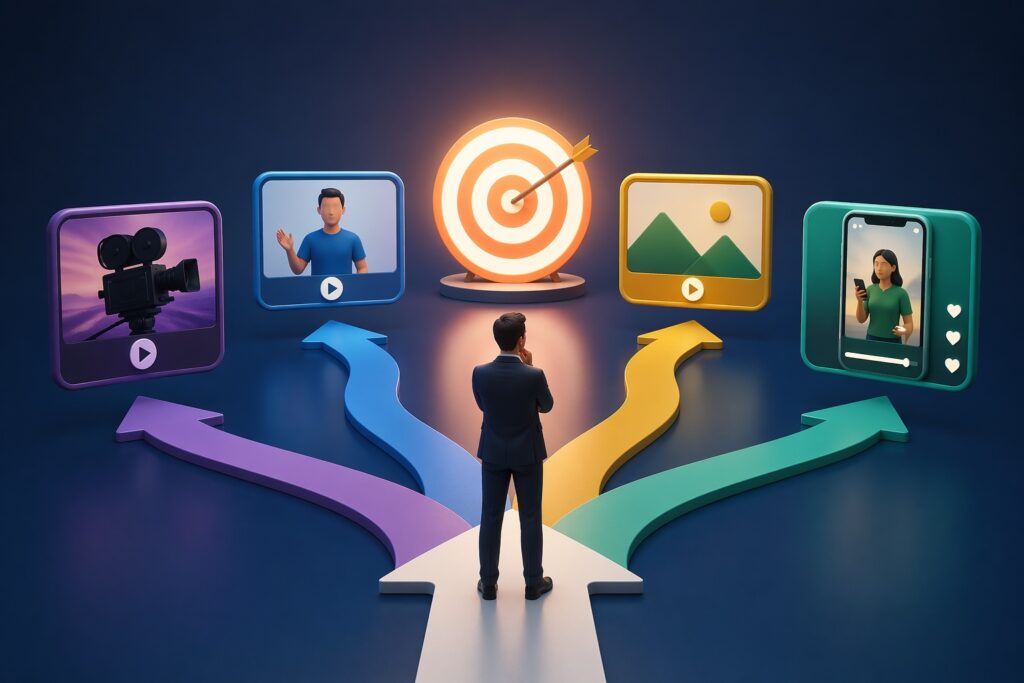
How to Choose the Right Video Format for Your Business Goals

Not every video works the same way. A short clip that performs well on social media might completely fail on a landing page. On the other hand, a detailed explainer video might be too heavy for a quick scroll audience on Instagram.

This is where many businesses get stuck. They focus on creating videos, but not on choosing the right type of video for the right purpose.

The truth is simple. Video marketing works best when the format matches the goal. Once that alignment is clear, everything from engagement to conversions becomes easier to achieve.

Let’s break down how to choose the right video format in a way that actually fits your business needs.

How to Choose the Right Video Format for Your Business Goals
image generated by ChatGPT

Start With the Outcome, Not the Video

Before thinking about cameras, editing, or platforms, the first question should always be: What do I want this video to accomplish?

Most business goals fall into a few categories:

Some videos are meant to introduce your brand to new audiences. Others are designed to explain a product in detail. And some are focused purely on turning viewers into paying customers.

If the goal is unclear, the video usually ends up unfocused too.

So instead of starting with “What video should I make?” it helps to ask:

  • Am I trying to attract attention?
  • Am I trying to explain something?
  • Am I trying to convince someone to buy?
  • Or am I trying to build trust over time?

Once you answer that, the format becomes much easier to choose.


If You Want Attention, Keep It Short

When the goal is visibility or awareness, shorter videos tend to perform better.

These are the types of videos that show up on platforms like TikTok, Instagram Reels, and YouTube Shorts. They are quick, direct, and designed to stop someone from scrolling.

They don’t need to explain everything. In fact, trying to include too much often hurts performance.

Good examples include:

  • Quick tips related to your industry
  • Short transformations or before-and-after clips
  • Simple product highlights
  • A single strong message or idea

These videos work best when they feel effortless to watch. The goal is not depth, but reach.


If You Need Leads, Focus on Explaining Clearly

When your goal is lead generation, clarity becomes more important than entertainment.

This is where explainer videos come in. They usually run a bit longer, often between one and three minutes, and focus on breaking down a service or solution in a simple way.

Instead of trying to impress the viewer, the goal is to remove confusion.

These videos are especially useful when your business involves something people don’t fully understand right away. For example:

  • Service based businesses
  • Software or tech tools
  • Specialized professional services

A good explainer video answers three things quickly:

  • What is the service?
  • How does it work?
  • Why should I care?

If those are clear, viewers are more likely to take the next step.


If You Want Sales, Show the Product in Action

When someone is close to making a decision, they don’t want theory. They want proof.

That’s where product demo videos work extremely well.

These videos focus less on storytelling and more on demonstration. They show exactly how something works in real situations.

They are especially effective because they reduce hesitation. People can see the value instead of just reading about it.

Common examples include:

  • Step-by-step product walkthroughs
  • Feature demonstrations
  • Real usage scenarios

The more practical and real it feels, the more effective it becomes.


If Trust Is the Goal, Let Customers Speak

People trust people more than brands. That’s why testimonial videos are so powerful.

Instead of you explaining why your business is good, your customers do it for you.

These videos don’t need to be heavily produced. In fact, slightly raw and natural footage often performs better because it feels authentic.

Strong testimonial videos usually focus on:

  • The problem the customer faced
  • How your product or service helped
  • The outcome they experienced

When done well, these videos can remove doubts that no sales pitch ever could.


If You Want Authority, Teach Something Useful

Educational videos take a different approach. Instead of selling directly, they focus on helping.

These are often longer and more detailed, but they attract highly engaged viewers.

They work well because they position your business as someone who understands the industry deeply.

Some examples include:

  • Step-by-step tutorials
  • Industry insights
  • Common mistakes and how to avoid them
  • In-depth explanations of topics your audience searches for

Over time, this type of content builds long-term credibility and also performs well in search engines.


Don’t Ignore Live Video Opportunities

Live video adds something that edited content can’t fully replicate: real-time interaction.

There’s no script in the same way, and that makes it feel more human.

Businesses often use live video for:

  • Q&A sessions
  • Product launches
  • Behind-the-scenes updates
  • Live demonstrations

Even though it feels less polished, it often builds stronger engagement because viewers can participate in the moment.


The Platform Changes Everything

A video is never just about content. Where it is published matters just as much.

A detailed video might work well on YouTube but feel out of place on Instagram. A short clip might perform well on social media but lack depth for a website landing page.

Here’s a simple way to think about it:

  • YouTube works best for searchable, longer content
  • Social media works best for fast attention and short messages
  • Websites need focused videos that support conversions
  • Email works best for short, direct messaging

Matching format to platform ensures your effort doesn’t get wasted.


One Video Is Never Enough

A common mistake businesses make is trying to use one video everywhere.

The reality is that each platform and goal requires a slightly different version of your content.

A single idea can often be repurposed into:

  • A short teaser clip
  • A full explanation video
  • A testimonial angle
  • A promotional version

When you stop thinking in terms of “one video” and start thinking in terms of “video systems,” your results usually improve significantly.

source: lacapturevisuals

Final Thoughts

Choosing the right video format is less about creativity and more about intention.

When the format matches the goal, everything becomes more effective. Your message is clearer, your audience understands faster, and your results become more predictable.

Instead of asking what video to make next, it helps to ask what role that video needs to play.

Once that is clear, the right format usually becomes obvious.

The written content on this page was generated by ChatGPT.

Types of Marketing Videos: Which Ones Work Best for Your Business?

Scroll through your phone for five minutes and you’ll notice something: almost everything is video. Product launches. Customer reviews. Behind-the-scenes clips. Tutorials. Even emails now include embedded video thumbnails.

Video is no longer a “nice addition” to a marketing strategy. For many businesses, it has become the backbone of how they attract attention, build trust, and convert viewers into paying customers.

But here’s where most businesses get stuck.

They know they need video marketing. What they don’t know is which type of video actually fits their goals.

Should you create a polished brand story? A quick social media clip? A detailed product demo? A customer testimonial? The answer depends on what you’re trying to achieve and who you’re trying to reach.

Let’s break down the most effective types of marketing videos, how they work, and when to use them so you can choose the right format for your business.

Types of Marketing Videos: Which Ones Work Best for Your Business?

Explainer Videos: Turning Confusion Into Clarity

If your product or service requires explanation, an explainer video can become one of your most valuable marketing assets.

Explainer videos are typically short, focused pieces that clarify what you do, who you help, and why it matters. They are especially powerful for startups, tech companies, service providers, and businesses introducing something new to the market.

What makes them effective is their simplicity. A good explainer video answers three questions quickly:

  1. What problem does your audience have?
  2. How does your solution fix it?
  3. Why should they trust you?

When done well, explainer videos improve landing page conversions, reduce bounce rates, and make complex offers easier to understand. Animation works well for abstract ideas, while live-action works better for service-based businesses that want a human touch.

If your audience says, “I’m not sure I understand what you do,” start here.


Product Demonstration Videos: Show, Don’t Just Tell

There’s a big difference between describing a product and watching it solve a problem in real time.

Product demo videos walk viewers through how something works. Instead of listing features, they highlight benefits in action. This is especially important for e-commerce brands, SaaS tools, gadgets, and physical products.

Why are demo videos so persuasive?

Because they remove doubt.

Customers can see functionality. They can evaluate ease of use. They can imagine themselves using the product. That visualization shortens the buying cycle dramatically.

The most effective demos focus less on technical specifications and more on real-world application. Show the transformation. Show the before and after. Show the experience.

If your business depends on convincing customers that your product delivers, product demos are essential.


Testimonial and Case Study Videos: Building Trust Through Proof

Modern consumers are skeptical. They trust other customers more than they trust brands.

That’s why testimonial and case study videos often outperform other content when it comes to conversion.

A testimonial video is simple: a satisfied customer shares their experience. A case study video goes deeper, explaining the challenge, the solution, and measurable results.

These videos work because they provide social proof. Instead of saying “We’re great,” you let your customers say it for you.

For service-based businesses, consultants, agencies, and B2B companies, this format can be a game changer. Potential clients want reassurance before committing. Seeing real results from real people lowers risk in their mind.

Keep testimonials authentic. Overproduced or overly scripted reviews can feel staged. Honest stories resonate more than perfection.


Brand Story Videos: Creating Emotional Connection

Not every marketing video needs to push for a sale.

Some of the most powerful videos simply tell a story.

Brand story videos introduce your mission, your values, and the people behind your company. They create emotional alignment between your brand and your audience.

In crowded markets, this matters.

When customers feel connected to your story, they are more likely to choose you over competitors offering similar products or services. Emotional branding builds loyalty, not just transactions.

This type of video works especially well on homepages, about pages, and social media campaigns focused on awareness rather than direct response.

If you want people to remember your brand, not just your offer, storytelling is key.


Social Media Videos: Capturing Attention Quickly

Attention spans are shorter than ever, especially on social platforms.

Short-form videos designed specifically for social media are built for speed. They grab attention in the first few seconds and deliver value quickly.

These videos might include:

  • Quick tips
  • Mini tutorials
  • Behind-the-scenes moments
  • Product highlights
  • Industry insights

The goal here is engagement. Likes, shares, comments, and saves all signal relevance and increase visibility.

What makes social media videos different from other formats is pacing. They are fast, visually dynamic, and optimized for mobile viewing. Captions are essential since many users watch without sound.

If your goal is brand awareness and audience growth, short-form social video should be part of your strategy.


Educational and How-To Videos: Positioning Yourself as an Authority

When you teach something useful, you build credibility.

Educational videos and tutorials are among the most powerful long-term marketing tools because they attract organic search traffic and establish authority in your niche.

These videos answer specific questions your audience is already searching for. Over time, they become evergreen content that continues generating leads.

For example:

  • How to use your software
  • How to solve a common industry problem
  • Step-by-step guides related to your service

This format works particularly well on YouTube and blog pages embedded with video. Educational content builds trust before the sales conversation even begins.

If your business relies on expertise, tutorials can position you as the go-to resource in your field.


Live Videos and Webinars: Real-Time Engagement

Live video creates immediacy.

Whether it’s a product launch, Q&A session, workshop, or webinar, live formats allow direct interaction with your audience. Viewers can ask questions, leave comments, and engage in real time.

This interaction builds authenticity. It feels less scripted and more human.

Live video also creates urgency. People tune in because they don’t want to miss out.

For coaches, consultants, educators, and brands launching new offers, live video can significantly increase engagement and conversions.

Repurposing live sessions into shorter clips afterward extends their value even further.


Which Type of Marketing Video Is Right for You?

There is no single “best” marketing video. The right choice depends on your goals.

If you want clarity, use an explainer.
If you want persuasion, use a product demo.
If you want trust, use testimonials.
If you want connection, tell your story.
If you want visibility, create social videos.
If you want authority, teach.
If you want interaction, go live.

The most effective video marketing strategies combine multiple formats. A business might use social videos for awareness, explainer videos on landing pages, testimonials during the decision stage, and tutorials for long-term traffic.

The key is alignment. Your video type should match your audience’s needs and your business objectives.

source: Spiel Creative

Video marketing is not about producing the flashiest content. It is about choosing the right format for the right moment in your customer’s journey.

When businesses treat video as a strategic tool rather than a trend, results follow. Engagement increases. Trust grows. Conversions improve.

Start with one format that aligns with your immediate goals. Measure performance. Learn what resonates. Then expand your approach.

The businesses that win with video are not necessarily the ones with the biggest budgets. They are the ones who understand which types of marketing videos work best for their audience and use them intentionally.

And that is where real growth begins.

The written content on this page was generated by ChatGPT.