Not every video works the same way. A short clip that performs well on social media might completely fail on a landing page. On the other hand, a detailed explainer video might be too heavy for a quick scroll audience on Instagram.
This is where many businesses get stuck. They focus on creating videos, but not on choosing the right type of video for the right purpose.
The truth is simple. Video marketing works best when the format matches the goal. Once that alignment is clear, everything from engagement to conversions becomes easier to achieve.
Let’s break down how to choose the right video format in a way that actually fits your business needs.
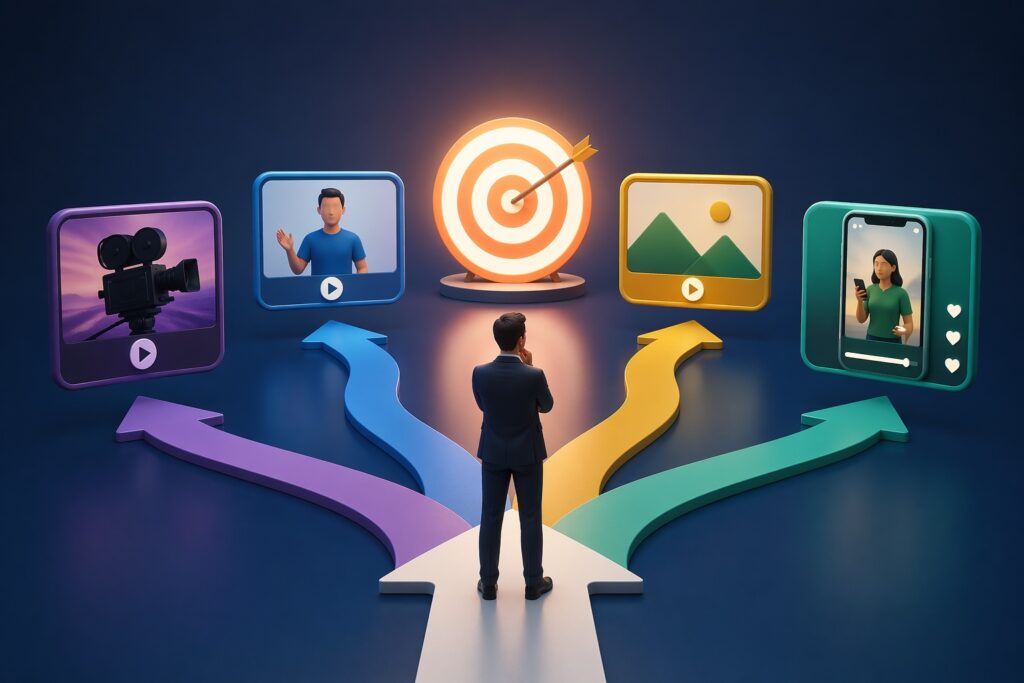
Start With the Outcome, Not the Video
Before thinking about cameras, editing, or platforms, the first question should always be: What do I want this video to accomplish?
Most business goals fall into a few categories:
Some videos are meant to introduce your brand to new audiences. Others are designed to explain a product in detail. And some are focused purely on turning viewers into paying customers.
If the goal is unclear, the video usually ends up unfocused too.
So instead of starting with “What video should I make?” it helps to ask:
- Am I trying to attract attention?
- Am I trying to explain something?
- Am I trying to convince someone to buy?
- Or am I trying to build trust over time?
Once you answer that, the format becomes much easier to choose.
If You Want Attention, Keep It Short
When the goal is visibility or awareness, shorter videos tend to perform better.
These are the types of videos that show up on platforms like TikTok, Instagram Reels, and YouTube Shorts. They are quick, direct, and designed to stop someone from scrolling.
They don’t need to explain everything. In fact, trying to include too much often hurts performance.
Good examples include:
- Quick tips related to your industry
- Short transformations or before-and-after clips
- Simple product highlights
- A single strong message or idea
These videos work best when they feel effortless to watch. The goal is not depth, but reach.
If You Need Leads, Focus on Explaining Clearly
When your goal is lead generation, clarity becomes more important than entertainment.
This is where explainer videos come in. They usually run a bit longer, often between one and three minutes, and focus on breaking down a service or solution in a simple way.
Instead of trying to impress the viewer, the goal is to remove confusion.
These videos are especially useful when your business involves something people don’t fully understand right away. For example:
- Service based businesses
- Software or tech tools
- Specialized professional services
A good explainer video answers three things quickly:
- What is the service?
- How does it work?
- Why should I care?
If those are clear, viewers are more likely to take the next step.
If You Want Sales, Show the Product in Action
When someone is close to making a decision, they don’t want theory. They want proof.
That’s where product demo videos work extremely well.
These videos focus less on storytelling and more on demonstration. They show exactly how something works in real situations.
They are especially effective because they reduce hesitation. People can see the value instead of just reading about it.
Common examples include:
- Step-by-step product walkthroughs
- Feature demonstrations
- Real usage scenarios
The more practical and real it feels, the more effective it becomes.
If Trust Is the Goal, Let Customers Speak
People trust people more than brands. That’s why testimonial videos are so powerful.
Instead of you explaining why your business is good, your customers do it for you.
These videos don’t need to be heavily produced. In fact, slightly raw and natural footage often performs better because it feels authentic.
Strong testimonial videos usually focus on:
- The problem the customer faced
- How your product or service helped
- The outcome they experienced
When done well, these videos can remove doubts that no sales pitch ever could.
If You Want Authority, Teach Something Useful
Educational videos take a different approach. Instead of selling directly, they focus on helping.
These are often longer and more detailed, but they attract highly engaged viewers.
They work well because they position your business as someone who understands the industry deeply.
Some examples include:
- Step-by-step tutorials
- Industry insights
- Common mistakes and how to avoid them
- In-depth explanations of topics your audience searches for
Over time, this type of content builds long-term credibility and also performs well in search engines.
Don’t Ignore Live Video Opportunities
Live video adds something that edited content can’t fully replicate: real-time interaction.
There’s no script in the same way, and that makes it feel more human.
Businesses often use live video for:
- Q&A sessions
- Product launches
- Behind-the-scenes updates
- Live demonstrations
Even though it feels less polished, it often builds stronger engagement because viewers can participate in the moment.
The Platform Changes Everything
A video is never just about content. Where it is published matters just as much.
A detailed video might work well on YouTube but feel out of place on Instagram. A short clip might perform well on social media but lack depth for a website landing page.
Here’s a simple way to think about it:
- YouTube works best for searchable, longer content
- Social media works best for fast attention and short messages
- Websites need focused videos that support conversions
- Email works best for short, direct messaging
Matching format to platform ensures your effort doesn’t get wasted.
One Video Is Never Enough
A common mistake businesses make is trying to use one video everywhere.
The reality is that each platform and goal requires a slightly different version of your content.
A single idea can often be repurposed into:
- A short teaser clip
- A full explanation video
- A testimonial angle
- A promotional version
When you stop thinking in terms of “one video” and start thinking in terms of “video systems,” your results usually improve significantly.
Final Thoughts
Choosing the right video format is less about creativity and more about intention.
When the format matches the goal, everything becomes more effective. Your message is clearer, your audience understands faster, and your results become more predictable.
Instead of asking what video to make next, it helps to ask what role that video needs to play.
Once that is clear, the right format usually becomes obvious.
The written content on this page was generated by ChatGPT.