Video content has a way of attracting attention almost effortlessly. A well-made clip can pull in thousands of views, likes, and shares in a short time. But once the excitement of those numbers fades, many businesses are left with the same question: why aren’t these views turning into actual customers?
That gap between attention and action is where most video marketing strategies fail. Views alone don’t keep a business running—sales do. And to get from one to the other, you need to understand what your videos are really doing behind the scenes.
Tracking video conversions is what turns video marketing from guesswork into a structured growth system. Once you can see exactly how people move from watching a video to taking action, you can start improving results in a meaningful way.
Understanding What “Conversion” Really Means in Video Marketing
Before you even think about tools or analytics, it’s important to get clear on what you’re actually tracking.
A conversion is simply the moment a viewer does something valuable for your business. That action can look different depending on what you sell or offer.
For some businesses, a conversion might be:
- A customer making a purchase
- Someone filling out a contact form
- A booking or appointment request
- Signing up for a free trial or newsletter
- Clicking through to a product or pricing page
What matters most is not the type of action, but the fact that it represents real intent. Without defining this clearly, your data becomes messy and your decisions become unreliable.
Why Views Alone Can Be Misleading
It’s easy to get caught up in surface-level numbers. A video with 50,000 views looks impressive, but it doesn’t automatically mean the business is growing. If none of those viewers take action, the video is not doing its job.
On the other hand, a smaller video with 1,500 views that generates steady leads every day is far more valuable.
This is where many businesses misjudge performance. They optimize for attention instead of outcomes. Tracking conversions shifts your focus to what actually matters: how many viewers become customers.
Setting Up the Right Tracking Foundation
To understand conversions properly, you need systems that connect video activity with user behavior. Without this, you are only seeing part of the picture.
Using Google Analytics to See What Happens After the View
Google Analytics plays a major role in understanding post-view behavior. It shows you what users do after they land on your website from a video.
You can track things like:
- Pages visited after watching
- Time spent on your site
- Whether users complete a goal or drop off
This helps you connect video traffic to actual business outcomes instead of isolated engagement metrics.
Understanding Audience Behavior with YouTube Insights
YouTube Studio gives you a detailed look at how people interact with your videos directly on the platform.
You can study:
- Audience retention (where viewers stop watching)
- Click-through rates on thumbnails
- Watch time trends
- Traffic sources
These signals help you understand whether your content is holding attention long enough to influence action.
Tracking Actions with Event Tools
Google Tag Manager allows you to go deeper by tracking specific user actions on your site.
Instead of guessing, you can measure:
- Button clicks inside or below videos
- Form submissions after viewing
- Scroll behavior on landing pages
- Custom conversion events
This is especially useful when videos are embedded on service pages or product pages.
Connecting Video Views to Real Customer Journeys
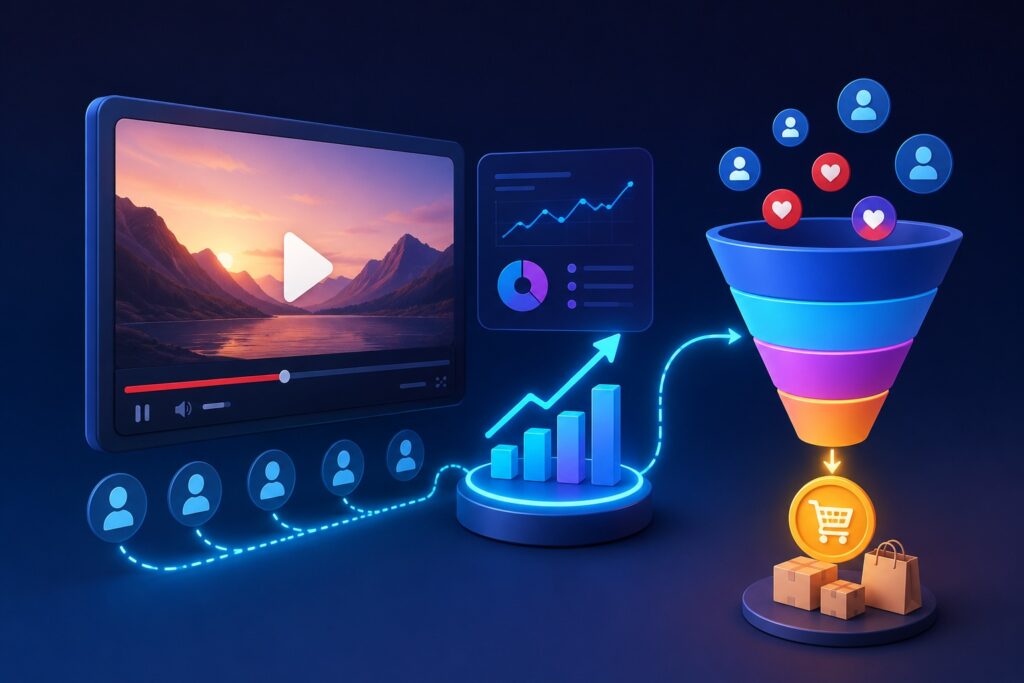
One of the most important shifts in thinking is understanding that conversions rarely happen instantly. Most users don’t watch a video and buy immediately.
Instead, they move through a journey:
- They watch your video
- They click through to learn more
- They explore your website
- They return later when ready to buy
If you only measure the first step, you miss the bigger picture.
That’s why tracking needs to follow the entire path—not just the initial view.
The Role of Strong Calls-to-Action
Even the best video will struggle to convert if it doesn’t clearly guide the viewer.
A call-to-action is what connects interest to action. Without it, viewers are left unsure of what to do next.
Effective CTAs might include:
- “Visit our website to learn more”
- “Get a free quote today”
- “Start your free trial”
- “Book your consultation now”
The key is clarity. A video should never end without a clear next step.
Why Landing Pages Matter More Than You Think
A video can spark interest, but a landing page is often where the decision actually happens.
If your landing page doesn’t match the message of your video, conversions drop quickly. Consistency is everything.
A strong landing page should:
- Reinforce what the video explained
- Focus on one main action
- Remove distractions
- Build trust through reviews or proof
When video and landing page work together, conversion rates increase significantly.
Using UTM Tracking to Understand What Actually Works
Once you start distributing videos across multiple platforms, it becomes harder to know where results are coming from.
This is where UTM tracking becomes useful. It allows you to see:
- Which video generated the lead
- Which platform drove the traffic
- Which campaign performed best
Instead of guessing, you get clear attribution for every conversion.
Improving Performance Through Real Data
Tracking alone doesn’t improve results. What matters is what you do with the information.
For example:
- If viewers drop off early → improve your hook or intro
- If clicks are low → test new thumbnails or titles
- If traffic is high but conversions are low → fix your landing page
- If engagement is strong → double down on that content style
Over time, this creates a feedback loop where each video performs better than the last.
Testing and Refining Your Video Strategy
A/B testing is one of the most effective ways to improve conversion rates without guessing.
You can test:
- Different video titles
- Thumbnail styles
- Call-to-action wording
- Landing page layouts
Even small changes can produce noticeable differences in performance. The goal is to let real user behavior guide your decisions, not assumptions.
Focusing on the Right Audience, Not Just Bigger Numbers
One of the most common mistakes in video marketing is chasing reach instead of relevance.
A highly targeted audience that is already interested in your service will always outperform a large general audience.
Better targeting leads to:
- Higher engagement
- Better retention
- Stronger conversion rates
- More predictable sales
At the end of the day, it’s not about how many people watch—it’s about whether the right people are watching.
Final Thoughts
Video marketing becomes truly powerful when it stops being about visibility and starts being about outcomes. Views are only the beginning. The real value comes from understanding what happens after those views.
When you combine proper tracking systems, clear conversion goals, strong calls-to-action, and continuous optimization, your videos stop being just content—they become a consistent source of leads and sales.
The difference between struggling video campaigns and profitable ones usually comes down to one thing: knowing exactly how attention turns into action.
The written content on this page was generated by ChatGPT.