Creating a marketing video takes time, money, and planning. But once a video has been published, many businesses simply move on to the next piece of content. That can be a mistake.
An older marketing video may still contain useful information, a strong message, or footage that could attract customers today. Instead of abandoning it, businesses can often improve the performance of an old marketing video by updating its packaging, refreshing its message, improving its distribution, and connecting it to newer content.
You don’t always need to produce an entirely new video to get better results. Sometimes, a few strategic changes can give an existing video another opportunity to reach the right audience.
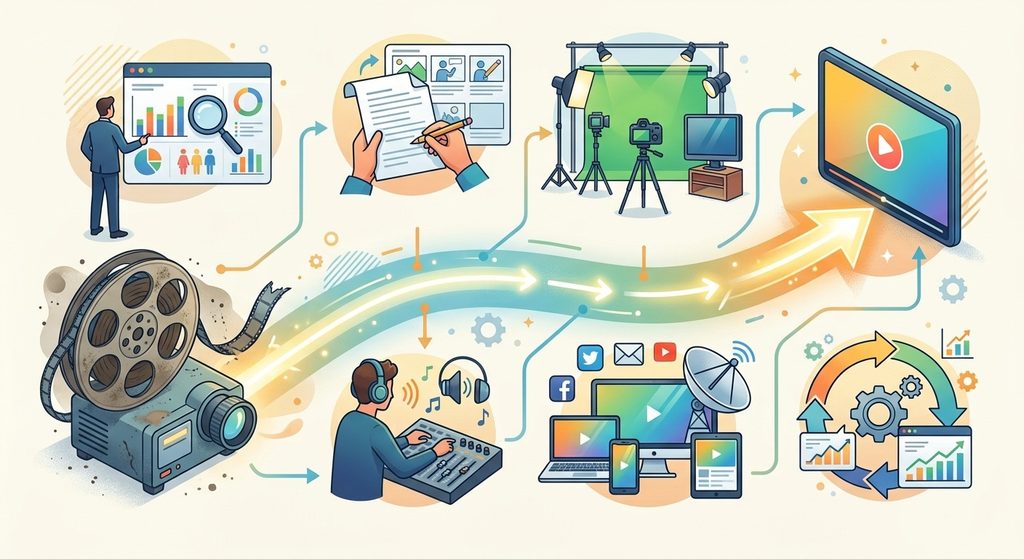
Start by Reviewing the Video’s Current Performance
Before changing anything, determine why the video is underperforming.
Look at available analytics and ask:
- How many people are watching?
- Where are viewers discovering the video?
- How long do they typically watch?
- Where are viewers leaving?
- Is the video generating website visits or leads?
- Has interest in the topic changed?
- Is the video still relevant to your target customer?
This information helps you avoid making changes based purely on guesswork.
For example, a video may have a useful message but receive very few clicks because its title and thumbnail are weak. Another may attract plenty of viewers but lose most of them during the opening because it takes too long to get to the point.
Those are two completely different problems and require different solutions.
Update the Video Title
One of the simplest ways to improve an old marketing video is to reconsider its title.
Older videos are sometimes given titles that make sense internally but don’t clearly communicate their value to potential customers. A better title should tell people what they can expect while naturally incorporating the topic they’re interested in.
YouTube recommends accurate, concise titles that help viewers understand what a video is about. It also advises putting the most important words toward the beginning of the title.
For example, instead of:
Our Company’s Marketing Approach
consider:
How Small Businesses Can Get More Customers With Video Marketing
The second title immediately communicates the subject and potential benefit.
Don’t turn the title into a string of keywords, though. The goal is to make it useful to humans first.
Create a Better Thumbnail
A thumbnail can determine whether someone stops scrolling and considers watching your video.
If an old video has a dated, cluttered, blurry, or generic thumbnail, replacing it may make the content more appealing to new viewers.
A strong business video thumbnail should:
- Clearly communicate the subject
- Be easy to understand at a small size
- Avoid unnecessary visual clutter
- Create curiosity without misleading viewers
- Work well on both desktop and mobile devices
- Match the actual content of the video
YouTube specifically recommends experimenting with updated thumbnails for older videos and using analytics to understand how titles and thumbnails affect performance.
If your channel has access to YouTube’s native A/B testing feature, older videos can be particularly useful candidates for testing different titles and thumbnails. YouTube currently allows eligible creators to compare up to three combinations, with the test evaluating performance based on watch time.
Improve the Video Description
An old description may be short, outdated, or missing important information.
Rewrite it so that it accurately explains what viewers will learn and gives them a reason to continue exploring your business.
Include relevant information such as:
- What the video covers
- Who the video is intended for
- Important products or services mentioned
- Links to relevant pages on your website
- Related videos
- A useful call to action
- Relevant timestamps when appropriate
Avoid stuffing the description with repetitive keywords. A natural explanation is more useful to visitors and provides clearer context.
Add a Stronger Call to Action
An old video may educate viewers but fail to tell them what to do next.
Consider what action makes sense for someone who has just watched the video.
Depending on your business, that could be:
- Visit a service page
- Request a quote
- Schedule a consultation
- Download a guide
- Read a related article
- Watch another video
- Contact your business
- Sign up for an email list
The call to action should fit the viewer’s position in the buying process.
A beginner watching an educational video may not be ready to make a purchase. Sending that person to another helpful resource could be more effective than immediately asking for a sale.
Connect the Old Video to New Content
One of the best ways to revive an older video is to surround it with newer content.
Suppose you published a video about creating social media videos several years ago. Since then, you’ve published articles about short-form video, video SEO, content repurposing, and video analytics.
Link the older video from those newer pages where it genuinely adds value.
You can also create a new video that expands on the original topic and directs viewers toward the older resource.
This creates a network of related content rather than leaving the old video isolated.
Refresh Outdated Information
This is especially important for marketing videos.
Platforms, advertising options, software, pricing, social media features, and consumer behavior can change quickly. A video that was accurate several years ago may now contain information that is incomplete or outdated.
Review the video carefully.
Ask:
Is everything still accurate?
If the changes are minor, you may be able to update the title, description, links, and supporting content.
If the actual information inside the video is significantly outdated, consider creating a new version rather than pretending the old video is current.
You can then use the older video to introduce viewers to the updated version.
Improve the Video’s Search Visibility
Video SEO can help people discover your content through search engines.
For videos published on your own website, Google recommends making the video discoverable and indexable, using appropriate video metadata, providing stable thumbnail URLs, and considering structured data such as VideoObject. Videos can potentially appear in Google Search, Video mode, Google Images, and Discover.
If you embed an older video on your website, don’t simply place the video on a page with little surrounding information.
Build a useful page around it.
For example, an article about How to Market a Small Business With Video could include:
- An introduction
- The embedded video
- A written explanation
- Key takeaways
- Frequently asked questions
- Related resources
- Links to relevant services or products
This gives visitors additional information and provides search engines with more context about the page.
Add Chapters or Key Moments
Longer videos can become easier to navigate when important sections are clearly identified.
If your video covers several distinct subjects, consider adding timestamps or chapters.
For YouTube videos, timestamps can help viewers jump directly to the sections they’re interested in. Google can also use information about important video segments for features such as key moments.
For example:
00:00 Introduction
01:15 Choosing a Video Topic
03:40 Creating the Script
06:10 Promoting Your Video
09:25 Measuring Results
This can make an older long-form video feel considerably more useful without changing the actual footage.
Repurpose the Video
Don’t limit an old marketing video to its original platform.
A single video can become the foundation for several pieces of content.
You might turn it into:
- Short social media clips
- Blog content
- Email content
- LinkedIn posts
- Instagram Reels
- YouTube Shorts
- Frequently asked questions
- Sales resources
- Website content
This is particularly valuable for small businesses that don’t have the time or budget to create completely new videos every week.
The original video becomes a content asset rather than a one-time publication.
Promote the Video Again
Sometimes the problem isn’t the video itself. It simply isn’t being promoted anymore.
If the subject is still relevant, bring the video back into your marketing.
You could feature it in a newsletter, include it in a relevant blog article, share a short clip on social media, or use it as part of an email campaign.
You can also promote an older video when something changes in the market that makes its topic relevant again.
An older video isn’t automatically obsolete just because it isn’t new.
YouTube itself notes that older videos can experience renewed interest when a topic becomes more popular, new viewers discover a channel, or another video causes viewers to explore earlier content.
Improve the First Few Seconds
If you can edit the original footage, pay particular attention to the opening.
Viewers need to understand quickly why they should continue watching.
Remove unnecessary introductions, long logos, excessive greetings, or unrelated opening footage when possible.
Start with the problem, question, result, or benefit the viewer came to find.
For example:
Weak opening:
“Hi everyone, welcome back to our channel. Today we’re going to talk about…”
Stronger approach:
“Your business may already have everything it needs to create better marketing videos. Here’s how to turn your existing footage into content that generates more leads.”
YouTube emphasizes the importance of the opening seconds and recommends making sure the introduction delivers on the promise established by the title and thumbnail.
Don’t Change What Is Already Working
Refreshing an old video doesn’t mean changing every element.
If a video is already generating strong traffic, watch time, leads, or sales, be careful about making unnecessary changes.
Look for weaknesses rather than fixing things simply because they’re old.
YouTube explains that changing a title or thumbnail can affect performance because viewers may respond differently to the new presentation—not simply because the change itself gives the video a ranking boost.
That distinction matters.
The objective isn’t to make an old video look new. It’s to make a good piece of content more useful and easier for the right audience to discover.
Know When to Replace the Video
Not every old marketing video is worth saving.
Sometimes the better choice is to create a new version.
Consider replacing the video when:
- The information is substantially outdated
- The business has changed significantly
- The product or service no longer exists
- The production quality damages your brand
- The target audience has changed
- The original message no longer matches your strategy
- The video receives little engagement despite repeated optimization
Even then, don’t automatically delete the old content. First determine whether it has valuable backlinks, search traffic, historical engagement, or other useful signals.
Build a Regular Video Refresh Process
Video optimization shouldn’t happen only when something goes wrong.
Set aside time every few months to review older marketing videos.
Create a simple process:
Step 1: Identify older videos with existing traffic or engagement.
Step 2: Review their analytics.
Step 3: Find opportunities to improve titles, thumbnails, descriptions, links, and calls to action.
Step 4: Check whether the information is still accurate.
Step 5: Repurpose useful sections into new content.
Step 6: Monitor performance after making changes.
Step 7: Keep the improvements that produce meaningful results.
Over time, this turns your existing video library into a growing marketing resource.
Final Thoughts
An old marketing video isn’t necessarily a failed marketing video.
It may simply need better positioning.
A stronger title can make the subject clearer. A refreshed thumbnail can make the video more appealing. Updated descriptions and links can improve the viewer journey. New supporting content can bring additional traffic. Analytics can reveal exactly where viewers are losing interest.
Most importantly, don’t assume that every marketing problem requires creating something from scratch.
Before spending money producing another video, look through your existing library. You may already have valuable content that can be improved, repackaged, updated, and promoted to a new audience.
The best video marketing strategy isn’t always about creating more videos. Sometimes, it’s about getting more value from the videos you already have.
The written content on this page was generated by ChatGPT.