Video has become one of the most powerful ways to reach an online audience. From product demos to educational tutorials and brand storytelling, businesses rely heavily on video to communicate their message. However, publishing a great video alone does not guarantee visibility in search results. For your content to perform well online, search engines must be able to understand what your video contains.
This is where closed captions and transcripts play a crucial role. These tools do far more than improve accessibility. When implemented properly, captions and transcripts can significantly strengthen your video SEO strategy by helping search engines interpret your content, increasing engagement, and improving discoverability across multiple platforms.
Below is a deeper look at how closed captions and transcripts work and why they should be part of every video marketing strategy.
What Are Closed Captions and Transcripts?
Before exploring their SEO benefits, it helps to understand the difference between the two.
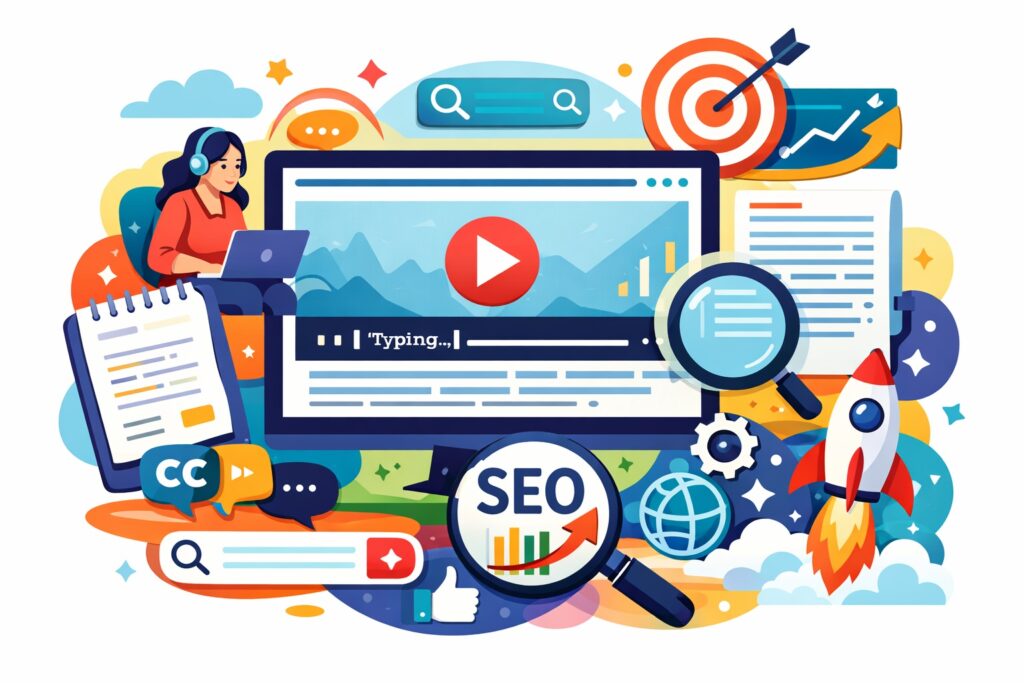
Closed captions are synchronized text that appears on the screen during a video. They represent spoken dialogue and often include sound descriptions such as music cues or background noises.
Transcripts, on the other hand, are complete written versions of everything said in a video. They are usually displayed below the video on a webpage or provided as a downloadable text document.
While both serve accessibility purposes, they also provide valuable text data that search engines can crawl and analyze.
Why Search Engines Need Text to Understand Video
Search engines are excellent at scanning written content, but they still rely heavily on text to interpret multimedia. While artificial intelligence is improving the ability to recognize images and speech, written words remain the most reliable way for search engines to determine the topic of a video.
If a video is uploaded without captions or transcripts, search engines have limited information to work with. They might only rely on the title, description, and tags. This restricts how accurately the content can be indexed.
Adding captions and transcripts solves this problem by converting spoken words into searchable text. Suddenly, your video contains hundreds or even thousands of additional keywords and contextual signals that search engines can evaluate.
The result is better indexing and greater chances of appearing in search results.
Increased Keyword Relevance
One of the biggest advantages of transcripts is the natural inclusion of keywords.
When people speak in videos, they often mention related terms, phrases, and questions that might not appear in a simple description or title. A transcript captures all of this language, creating a richer set of keywords for search engines to analyze.
For example, a video about video marketing may naturally include phrases such as:
- video optimization techniques
- improving YouTube rankings
- creating engaging marketing videos
- increasing video engagement
These phrases expand the semantic context of your content, which helps search engines match your video with a wider variety of user searches.
This organic keyword diversity can improve your chances of ranking for both primary keywords and long-tail search queries.
Improved Accessibility Expands Your Audience
Accessibility is another important factor that indirectly improves SEO performance.
Closed captions make videos accessible to people who are deaf or hard of hearing. They also help viewers who prefer watching videos without sound, which is common on mobile devices and social media platforms.
When more people are able to understand and engage with your content, watch time and engagement metrics increase. Search engines consider these metrics when determining the quality and relevance of a video.
Higher engagement often leads to better rankings.
Longer Watch Time and Viewer Retention
Viewer retention plays a critical role in video SEO. Platforms like video hosting sites track how long people watch a video before leaving.
Captions help viewers stay engaged for several reasons:
- They allow users to follow along in noisy environments.
- They make complex topics easier to understand.
- They help viewers who are not fluent in the spoken language.
Because captions improve comprehension, viewers are more likely to continue watching the video until the end.
Higher retention signals to search algorithms that the content provides value, which can positively influence rankings.
More Opportunities for Featured Snippets
Transcripts can also create opportunities for your content to appear in featured snippets within search results.
When a transcript is placed on a webpage below a video, search engines can easily extract answers from the text. If someone searches a question that your transcript addresses clearly, the search engine may display that section of text as a highlighted snippet.
This increases visibility and can drive additional traffic to your website.
Stronger On-Page SEO
Embedding a transcript on your webpage adds valuable written content that supports your overall SEO efforts.
Many video pages contain very little text aside from a short introduction. A transcript can dramatically increase the amount of indexable content on the page, which helps search engines understand the topic more thoroughly.
It also allows you to naturally include related keywords without forcing them into the content.
When combined with a well-written introduction, headings, and internal links, a transcript can transform a simple video page into a comprehensive piece of content that performs well in search results.
Better Indexing Across Video Platforms
Closed captions are particularly useful when uploading videos to hosting platforms. These platforms use captions to help categorize and recommend content.
When captions accurately reflect the dialogue in your video, the platform can better understand your subject matter. This increases the chances that your video will appear in recommended content feeds and search results within the platform itself.
Better categorization leads to increased visibility and more potential viewers.
How to Add Captions and Transcripts Effectively
While captions and transcripts are valuable, their quality matters.
Automatic captioning tools have improved significantly, but they are not always accurate. Reviewing and editing captions before publishing ensures that the text reflects the spoken content correctly.
Here are a few best practices:
Use accurate captions.
Errors can confuse both viewers and search engines.
Place transcripts on the same page as the video.
This allows search engines to crawl the text easily.
Structure transcripts clearly.
Breaking the transcript into paragraphs or sections improves readability.
Include speaker labels when relevant.
This is particularly useful for interviews or discussions.
Optimize surrounding content.
Add headings, summaries, and context around the transcript to strengthen the page’s SEO value.
Additional Benefits Beyond SEO
Although captions and transcripts are often discussed in the context of search rankings, they provide several additional benefits for content creators and businesses.
They make videos easier to repurpose into blog posts, social media captions, or marketing materials. The transcript essentially becomes a written asset that can be adapted into other forms of content.
Captions also improve the viewing experience for international audiences who may rely on text to better understand spoken language.
These advantages extend the lifespan and usefulness of your video content.
The Growing Importance of Video Accessibility
Online content is increasingly expected to be accessible to everyone. Many organizations and platforms encourage or require captioned video content to ensure inclusivity.
As accessibility standards become more widespread, captions and transcripts are no longer optional additions. They are becoming a standard practice for professional content creators and businesses.
Integrating them early in your video production process ensures your content remains competitive and widely accessible.
Final Thoughts
Closed captions and transcripts may seem like small details in the video creation process, but their impact on SEO and audience engagement is significant.
By converting spoken dialogue into searchable text, these tools help search engines understand your content, improve accessibility, increase viewer retention, and strengthen overall page optimization.
For businesses and creators looking to maximize the reach of their video content, captions and transcripts are among the most effective and overlooked SEO techniques available.
As video continues to dominate online marketing, incorporating these elements into every piece of content will not only improve search visibility but also create a better experience for viewers around the world.
The written content on this page was generated by ChatGPT.